String Courses and Configurations
Most Middle Eastern stringed instruments use courses — groups of two or three strings tuned in unison or at the octave and played as a single unit. Understanding why courses exist and how they affect the sound explains fundamental differences in timbre and technique across the instrument family.
What is a course?
Established A course is a group of strings placed close enough together to be struck or plucked simultaneously as one unit. A single course may contain one string (a single course), two strings (a double course), or three strings (a triple course). The strings within a course are tuned either in unison (same pitch) or at the octave.
Established Courses are not the same as individual strings. An oud with 11 strings has 6 courses (five double courses plus one single bass string). A qanun with 78 strings has 26 courses of three strings each. The player interacts with courses, not individual strings — each pluck or stroke engages the entire course.
Why courses?
Established Courses serve several acoustic and musical purposes:
- Volume: two or three strings vibrating together produce more sound than one, important for instruments without amplification
- Timbre richness: strings in a course never vibrate in perfect unison — the slight detuning between them creates a natural chorus effect, producing a fuller, richer tone than a single string
- Sustain: multiple strings share the energy of a single pluck, and their slightly different vibration patterns sustain the combined tone longer
- Octave resonance: when a course combines strings an octave apart, the result adds brightness and definition to the fundamental pitch
Course configurations by instrument
Established The major instruments of the makam and dastgah traditions use different course configurations, each producing a characteristic sound:
| Instrument | Strings | Courses | Configuration |
|---|---|---|---|
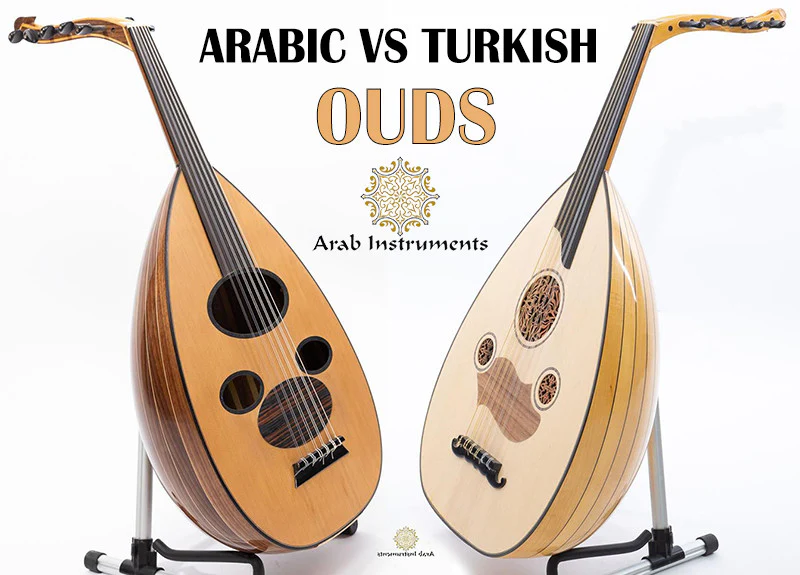
| Oud (Turkish) | 11 | 6 | 5 double + 1 single bass |
| Oud (Arabic) | 11–13 | 6–7 | 5–6 double + 1 single bass |
| Tanbur | 7–8 | varies | Complex: singles + doubles |
| Setar | 4 | 4 | 3 single + 1 doubled |
| Tar | 6 | 3 | 3 double courses |
| Bağlama/Saz | 7 | 3 | Configuration varies by size |
| Qanun | 78 | 26 | 26 triple courses |
| Santur | 72 | 18 | 18 quadruple courses |
The oud's course system
Attested The oud's five (or six) double courses are the most straightforward arrangement: each course consists of two strings tuned in unison. The lowest course is often a single string, as doubling a very thick bass string adds weight without proportional timbral benefit. The double courses give the oud its characteristic warm, full sound — richer than a single-string guitar, with the natural chorus of paired strings.
The tanbur's complex arrangement
Attested The tanbur uses a more complex string arrangement than simple doubled courses. Its configuration — which varies by maker and player — includes both single and doubled strings, with some courses tuned at the octave rather than in unison. This creates a composite timbre that combines the clarity of single strings with the richness of octave doubling.
The bağlama's variable courses
Attested The bağlama/saz family uses course configurations that vary by instrument size and regional tradition. A common arrangement for the standard-size bağlama uses seven strings in three courses: the lowest course with two strings, the middle with two, and the highest with three. But variations abound — different regional traditions and different instrument sizes use different configurations.
The qanun's triple courses
Attested The qanun's 26 triple courses give it a characteristically bright, ringing timbre. Three strings per course produce a strong attack and extended sustain, suited to the instrument's role as both melodic voice and harmonic backdrop. The mandal lever system adjusts all three strings in a course simultaneously, changing the course's pitch by precise microtonal increments.
Tuning implications
Practice Courses require more careful tuning than single strings. When two strings in a course are slightly out of tune, the resulting beating (a pulsing wavering in volume) can be pleasant at very small detunings (creating warmth) or unpleasant at larger ones (creating a wobbly, unfocused sound). Tuning courses to perfect unison is one of the most time-consuming aspects of maintaining these instruments.
Practice The tolerance for detuning varies by instrument and tradition. Oud players often accept a slight warmth in their courses. Qanun players, whose instrument functions as a pitch reference in the ensemble, typically demand more precise unison tuning.
Where to go from here
Individual instruments: Oud, Tanbur, Setar, Tar. The folk instrument family: Bağlama/Saz. The zither: Qanun. How to tune them: Practical Tuning Methods.
Sources
- Karl Signell, Makam: Modal Practice in Turkish Art Music (Asian Music Publications, 1977)Textbook / peer-reviewed
- Jean During, The Art of Persian Music (Mage Publishers, 1991)Textbook / peer-reviewed
- Wikipedia contributors, 'Course (music)'Secondary sourceView sourceRetrieved 2026-07-30
External Resources
Between Frets is not affiliated with or sponsored by any of the resources listed below. Links are provided for educational purposes only.
Documentary-style video exploring the history of the oud, combining performance with instrument education by an 8x ARIA Award-winning performer.
Hear how the oud's six double courses produce its characteristic shimmering sustain — the most familiar example of course tuning in the Middle Eastern tradition.
- Oud for Guitarists (Navid Goldrick)Established
YouTube channel teaching oud to musicians from a Western background, covering fretless intonation, quarter tones, right-hand technique, and maqam basics.
Excellent demonstrations of how the oud's paired course system differs from single-string Western instruments — the unison beating and timbre effects are clearly audible.
Explains the differences between short-neck and long-neck baglama including size, string course arrangements, tuning systems, and playing context.
See how course configurations vary across the baglama family — the same instrument family uses different numbers of strings per course depending on size and regional tradition.
Educational video introducing the tar instrument, covering its distinctive three double courses, the 'flying' bass string, and lambskin soundboard.
See the tar's unique course arrangement up close — including the sixth string added by Darvish Khan that runs outside the main fingerboard.
Overview of the setar covering its construction, the evolution from three to four strings, and the instrument's course configuration.
Understand the setar's unusual course layout — one paired bass-drone course plus two single strings, a configuration distinct from simple unison doubling.
- Organology.net — Kanun/QanunAttested
Academic-style encyclopedia entry on the qanun, including its triple-course string arrangement — three strings per note tuned in unison across a wide range.
The qanun's triple courses represent the most extreme course multiplication in this instrument family — 78 strings producing just 26 distinct pitches.
Related Articles
- InstrumentsThe Oud: History, Construction, and Playing TraditionsA guide to the oud — its deep history, bowl-back construction, fretless technique, and the distinct Turkish and Arabic traditions it anchors.
- InstrumentsThe Tanbur: The Instrument That Maps the CommasThe Ottoman long-necked lute whose frets physically embody the Holdrian comma system — its ancient lineage, exacting construction, mızrap technique, and central role in Turkish court music.
- InstrumentsThe Setar: Construction, Tuning, and the Persian Classical TraditionThe Persian long-necked lute of the dastgah tradition — its three-to-four-string history, mulberry-wood construction, four standard tunings, and quiet, fingernail-plucked technique.