The Oud: History, Construction, and Playing Traditions
The oud is a pear-shaped, fretless plucked lute at the root of both Turkish makam and Arabic maqam practice. Its name, playing technique, and tuning conventions have shaped modal music across the Middle East, North Africa, and Central Asia for over a millennium.
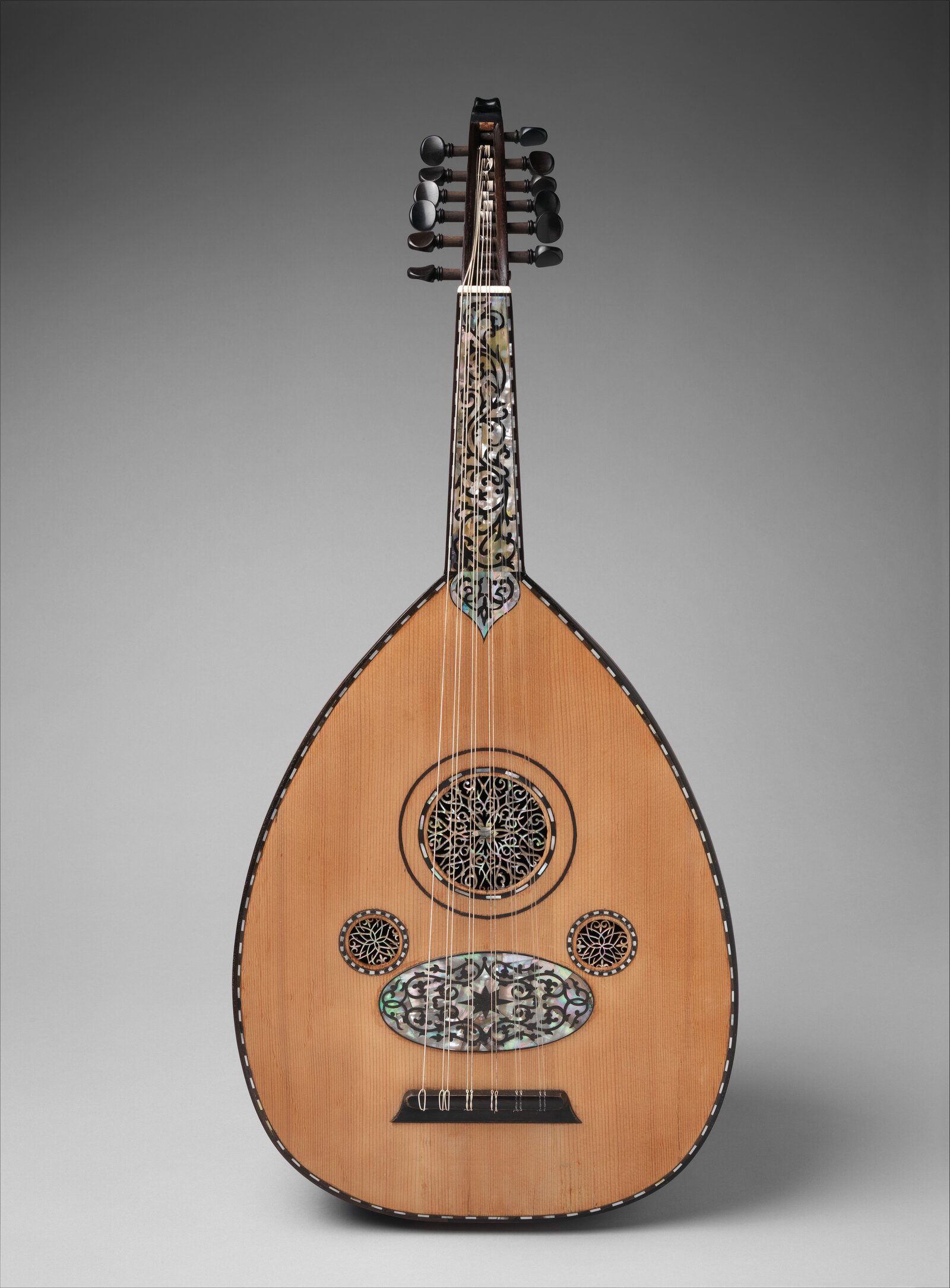
A brief history
Established The oud's lineage traces back to at least the 7th century CE in the Arabic-speaking world. Al-Farabi (d. 950) and later theorists described its tuning and fretting in detail, making it central to the codification of Islamic music theory. The instrument was already well established by the Abbasid period (750--1258 CE), when it served as the primary vehicle for musical theory and performance at court.
Attested The European word "lute" is a loanword from Arabic al-ʿūd, transmitted through Old Spanish laúd and Old French. The exact intermediate forms are debated by etymologists, but the Arabic origin is not in question. This etymological link reflects a genuine historical transmission: the oud entered medieval Europe through Iberia and Sicily, becoming the ancestor of the European lute family.
Uncertain The meaning of the Arabic word ʿūd itself (literally "wood" or "stick") and whether it originally referred to the plectrum, the body, or something else entirely, is a long-running scholarly debate without definitive resolution.
Construction
Established The oud has a deep, rounded bowl-back body assembled from thin staves (ribs) of wood, typically walnut, rosewood, or mahogany. The flat soundboard (face) is usually spruce, with one or more rosettes (decorative sound holes). The neck is short relative to the body — roughly one-third of the total string length — and crucially, it is fretless.
Established Having no frets, the player finds pitch positions entirely by ear and muscle memory relative to the open strings. There are no fixed markers on the neck. This fretless design is not an omission — it is what allows the oud to produce the microtonal intervals essential to both makam and maqam.
Established The oud is played with a long, flexible plectrum: called risha (Arabic) or mızrap (Turkish). Traditionally cut from an eagle feather quill, the plectrum is now usually made from plastic or horn. The angle, flexibility, and weight of the risha directly affect tone production.
Course structure
Established Modern ouds are typically strung with 11 or 13 strings arranged as five or six doubled courses (pairs tuned in unison) plus, on some instruments, an additional single bass string. The doubled courses produce the oud's characteristic rich, chorused tone.
Attested Common Turkish oud tuning (low to high): F#2 B2 E3 A3 D4 G4 (six courses), read by Turkish players in solfège as Fa#-Si-Mi-La-Re-Sol. Common Arabic tuning: C2 F2 A2 D3 G3 C4. However, there is significant variation — players adjust tunings for specific makam or maqam requirements, and historical sources describe many different configurations. One well-known Arabic variant, associated with Farid el-Atrache, uses D2 G2 A2 D3 G3 C4 — a sequence easily mistaken for the Turkish tuning above, but belonging to the Arabic tradition.
Turkish vs. Arabic traditions
The oud exists in two distinct but related traditions, each with its own construction preferences, playing style, and theoretical framework.
| Turkish oud | Arabic oud | |
|---|---|---|
| Scale length | Shorter (~58--61 cm) | Longer (~61--63 cm) |
| Body depth | Somewhat shallower | Deeper bowl |
| Pitch | Higher, brighter tone | Lower, warmer tone |
| Tuning (low to high) | F#2 B2 E3 A3 D4 G4 | C2 F2 A2 D3 G3 C4 |
| Theory framework | 53-comma AEU system | 24-quarter-tone notation |
| Playing style | More percussive risha work | More sustained, legato |
Practice This distinction matters for students: an Arabic oud method book teaches Arabic intonation. If you are studying Turkish makam, it will teach you pitches that are subtly wrong for the repertoire. Match your method book to your tradition.
Uncertain Exactly when the Turkish and Arabic construction and tuning conventions diverged into today's two recognizably different instruments is not sharply dated in the sources consulted for this article. The divergence was likely gradual, accelerated by the distinct theoretical codifications of the 19th and 20th centuries. Treat any specific century-level claim about this split with caution.
The oud in modal theory
Established The oud has historically served as the reference instrument for defining pitch positions (perde/parde) in both Turkish and Arabic-Persian theory. Al-Farabi and later theorists described intervals by specifying finger positions on the oud's strings. In this sense, the oud is not just an instrument — it is the instrument on which the theory was built.
Attested In modern Turkish conservatory practice, the oud remains a primary instrument for teaching makam, alongside the tanbur. The tanbur, with its moveable frets, can demonstrate precise comma-level intonation, while the fretless oud trains the ear directly.
The oud's tuning and left-hand technique are shared directly by the cümbüş, which borrows the oud's course layout and fingering relationships onto a metal-bodied resonator.
Sources
- New Grove Dictionary of Music and Musicians, s.v. "ʿŪd"Textbook / peer-reviewed
- Karl Signell, Makam: Modal Practice in Turkish Art Music (Asian Music Publications, 1977)Textbook / peer-reviewed
- Eckhard Neubauer, "Der Bau der Laute und ihre Besaitung nach arabischen, persischen und türkischen Quellen," Zeitschrift für Geschichte der arabisch-islamischen Wissenschaften, vol. 8 (1993)Textbook / peer-reviewed
- Wikipedia contributors, "Oud"Secondary sourceView sourceRetrieved 2026-07-29
External Resources
Between Frets is not affiliated with or sponsored by any of the resources listed below. Links are provided for educational purposes only.
- Oud for Guitarists (Navid Goldrick)Established
YouTube channel and Foundation Program teaching oud to musicians from a Western background, covering fretless intonation, quarter tones, right-hand technique, and maqam basics.
Bridges the gap between Western and Middle Eastern musical training, making the oud accessible to guitarists and other Western-trained instrumentalists.
Documentary-style video exploring the history of the oud instrument, combining performance with historical context and instrument education.
Provides an accessible, visually engaging introduction to the oud's history and construction from an award-winning performer.
- Anouar BrahemEstablished
Tunisian oud player and composer with 11 albums on the ECM label, blending Arabic classical music, folk, and jazz.
Listen to a contemplative, minimalist approach to the oud that demonstrates the instrument's range beyond traditional solo taqsim.
- Joseph Tawadros (@josephtawadros)Established
8x ARIA Award-winning Egyptian-Australian oud virtuoso. Performance reels, concert clips, and collaborations.
Follow a contemporary master for regular short-form content showing the oud in diverse musical contexts from chamber music to solo performance.
- MaqamWorld (Johnny Farraj)Established
The leading Internet reference on Arabic music theory, covering maqam scales, jins building blocks, rhythmic cycles, and traditional instruments. Companion book published by Oxford University Press.
The definitive English-language reference for understanding how the oud functions within the Arabic maqam system.
- Naseer Shamma Official ChannelAttested
Iraqi oud virtuoso, UNESCO Artist for Peace, and founder of the Arabic Oud House (Beit al-Oud) with branches across the Middle East.
Access solo taqasim and compositions from one of the most influential living oud players, representing the Iraqi school.
Live studio performance at WRTI 90.1 featuring Palestinian-American oud and violin virtuoso Simon Shaheen demonstrating Arab music on the oud.
An excellent introductory video for Western audiences, with studio-quality audio that clearly demonstrates oud tone and maqam improvisation.
Academic paper comparing historical tuning systems across tanbur, oud, tar, and saz
Primary source for cross-instrument tuning analysis — directly compares the tuning systems of instruments covered on this site
Related Articles
- Tuning SystemsHoldrian Commas and 53-TET: The Mathematics of Ottoman TuningHow the 53-tone equal temperament system and Holdrian commas became the theoretical language of Turkish makam intonation.
- Turkish MakamRast Makamı: Structure, Seyir, and PracticeA guide to Rast, the foundational Turkish makam — its interval structure in Holdrian commas, characteristic seyir, and role in the makam system.
- InstrumentsThe Cümbüş: Turkey's Metal-Bodied OudHow a 1930s Istanbul workshop turned the oud into a louder, cheaper instrument with a spun-aluminum body — its invention, construction, variants, and contested place in Turkish music.