The Tanbur: The Instrument That Maps the Commas
The tanbur is the instrument that turns theory into wire and gut. Where the oud trains the ear by leaving pitch positions unmarked, the tanbur does the opposite — its long neck carries dozens of precisely placed frets, each one a physical marker for a specific pitch in the Ottoman comma system. No other instrument in the Turkish tradition maps the theoretical framework onto a fingerboard this explicitly. If you want to see what the Holdrian comma system looks like in wood and metal, you look at a tanbur neck.
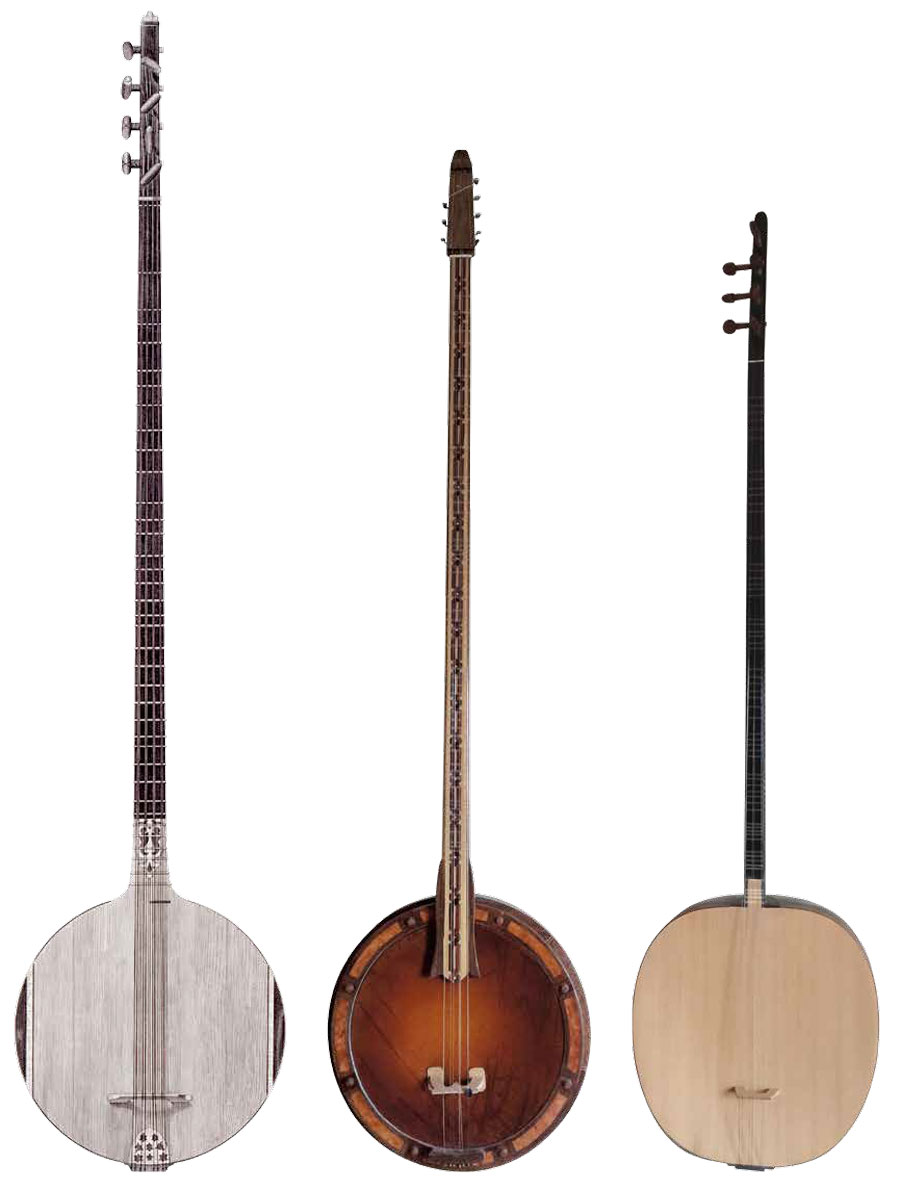
A deep lineage
Established The tanbur belongs to one of the oldest instrument families in the world. Long-necked lutes were present in Mesopotamia as early as the third millennium BCE, and figurines from Susa (c. 1500 BCE) depict instruments recognizable as tanbur ancestors. The name itself appears in Pahlavi (Middle Persian) texts from the fifth century CE, and Sasanian silver plates from the fifth through seventh centuries show musicians playing long-necked, small-bodied lutes.
Attested By the tenth century, Al-Farabi distinguished two types of tunbur — a Baghdad variety and a Khorasan variety — a division that may underlie the later split between Arabic short-necked lutes and the long-necked instruments found in Iran, Central Asia, and Turkey. The Ottoman tanbur descends from this long-necked lineage.
Established The Ottoman tanbur assumed roughly its modern form by the fifteenth century and matured as the premier instrument of Ottoman court music during the second half of the seventeenth century. New compositional forms — the pesrev, the saz semaisi, the taksim — were conceived with the tanbur's capabilities in mind, and the instrument became inseparable from the fasil suite tradition.
Construction
Established The tanbur is immediately recognizable by its proportions: a relatively small, hemispherical body and an exceptionally long neck. The body is assembled from 17, 21, or 23 thin ribs of hardwood — typically walnut, ebony, rosewood, or pearwood — joined edge to edge into a deep bowl roughly 30 to 35 cm in diameter. Older instruments sometimes had as few as 7 or 9 ribs. The soundboard is thin spruce (2.5--3 mm), slightly concave, and typically has no sound hole or only a very small opening — a feature that contributes to the tanbur's quiet, inward-focused tone.
Established The neck is the defining feature. Constructed from ebony or juniper, it runs 100 to 110 cm in length — far longer than any other instrument in the Ottoman ensemble — with a D-section profile only 4 to 4.5 cm across. The vibrating string length is approximately 104 to 106 cm. This extreme length is not decorative; it is what allows the frets to be spaced widely enough for a human finger to stop individual comma positions cleanly.
Practice The tanbur is famously fragile. The long, thin neck and gossamer soundboard are extremely sensitive to changes in temperature and humidity. Players traditionally loosen the strings when not performing to prevent the neck from warping and the soundboard from collapsing inward. Maintaining a tanbur demands constant vigilance — it is not an instrument you leave in a case and forget.
The fret system — commas made physical
Established The tanbur's frets are its most theoretically significant feature. Tied from gut (historically) or nylon around the neck and secured with minute nails, they are set to mark the pitch positions (perdeler) of the Ottoman makam system. The number of frets has varied across centuries and players: sources describe anywhere from the mid-thirties to as many as 48 frets within the first octave, depending on the period and the repertoire the instrument was set up to play.
Attested What makes the tanbur unique among Turkish instruments is that its fret layout physically embodies the Holdrian comma divisions described in the Arel-Ezgi-Uzdilek (AEU) theory. Where the oud player must find a 5-comma kucuk mucenneb interval by ear against an unmarked neck, the tanbur player has a fret for it. Where the kanun player flips mandals to shift pitch, the tanbur player moves to the next fret. Each fret position corresponds to a named perde in the system — rast, dik kurdi, segah, buselik, and so on — making the tanbur a physical reference chart for the entire pitch vocabulary.
Practice Because the frets are tied, not fixed, they can be adjusted. A player preparing for a specific makam may nudge a fret slightly to match the intonation that makam demands in practice (as opposed to its theoretical comma value). This adjustability is a feature, not a compromise — it acknowledges the gap between the 53-comma grid and the flexible intonation of a living performance tradition.
Strings and tuning
Attested Modern tanburs typically carry seven metal strings arranged in four courses: one single bass string and three doubled courses tuned in unison. Some historical instruments had eight strings, and six-string configurations also appear in older sources. Only the lowest course — the one closest to the frets — carries the melody. The upper courses ring sympathetically, adding the shimmering, halo-like sustain that distinguishes the tanbur's sound from that of any other plucked instrument in the tradition.
Uncertain Exact tuning conventions vary by source and period. A commonly cited modern tuning places the single bass string at A1 (yegah), with the three doubled courses above it. However, historical tunings differed, and players have always adjusted string pitches to suit the makam at hand — much as oud players retune the bam string. Treat any single tuning prescription as one option among several.
Playing technique — the mizrap
Established The tanbur is played with a long, thin plectrum called a mizrap (also spelled mizrab), traditionally cut from tortoiseshell — which is why the plectrum is also called baga ("turtle"). The mizrap is asymmetrically V-shaped, approximately 2 to 2.5 mm thick, 5 to 6 mm wide, and 10 to 15 cm long, polished to a smooth edge.
Practice The right-hand technique is distinctive. The player holds the mizrap between thumb and forefinger and strikes the strings with a light, controlled motion — closer to a brush than a dig. The left hand presses the string against the frets with minimal force, allowing the metal string to vibrate freely and produce the tanbur's characteristic transparent, bell-like tone. Heavy pressure kills the sound; the instrument rewards subtlety.
Two tanburs — mizrapli and yayli
Attested There are two performance variants of the tanbur. The mizrapli tanbur (plucked tanbur) is the classical instrument described throughout this article. The yayli tanbur (bowed tanbur) is played with a bow rather than a plectrum, producing sustained, singing tones. The yayli tanbur is widely attributed to Tanburi Cemil Bey, the legendary virtuoso of the late Ottoman period, who adapted bowing technique to the tanbur's long neck and metal strings.
The tanbur in Ottoman musical life
Established The tanbur held a position in Ottoman court music comparable to the harpsichord in Baroque Europe — it was the instrument of theory, the instrument of the composer, the instrument on which the system was demonstrated. Court musicians performed on the tanbur for sultans from the Classical Age (1444--1566) onward. Dimitrie Cantemir (1673--1723), the Moldavian prince and polymath who lived at the Ottoman court, was a celebrated tanbur player and described its fret system in detail in his Kitab-i Ilmu'l-Musiki (c. 1700).
Established The tanbur is also part of the Mevlevi instrumental ensemble — the group of musicians who accompany the sema, the whirling ceremony of the Mevlevi order. Alongside the ney (reed flute) and the kudüm (small kettledrums), the tanbur provides the melodic framework for the ayin, the extended compositional form performed during the ritual. This association gives the instrument a spiritual dimension beyond its court-music role.
Established The greatest tanbur player in Ottoman history is Tanburi Cemil Bey (1873--1916), whose recordings from 1910 to 1914 transformed the solo taksim into a virtuosic art form. Cemil Bey developed an agile, energetic picking style that broke from the tanbur's traditionally restrained manner, and his influence on subsequent generations of Turkish classical musicians is difficult to overstate. Other historic masters include Tanburi Isak (1745--1814), who taught Sultan Selim III, and in the modern era, Necdet Yasar (1930--2017), whose improvisations are considered definitive recordings of the makam repertoire.
Attested Following the establishment of the Turkish Republic in 1923, Ottoman classical music fell into official disfavor as a symbol of the old court culture. The tanbur, as the most emblematic instrument of that tradition, suffered a period of decline. Since the mid-twentieth century, however, renewed scholarly and pedagogical interest has restored the tanbur to conservatory curricula and concert stages.
Sources
- Karl Signell, Makam: Modal Practice in Turkish Art Music (Asian Music Publications, 1977)Textbook / peer-reviewed
- Walter Feldman, Music of the Ottoman Court (Intercultural Music Studies 10, VWB, 1996)Textbook / peer-reviewed
- Ozan Yarman, "79-tone Tuning & Theory for Turkish Maqam Music" (PhD diss., Istanbul Technical University, 2008)Practitioner-verified
- Robert Greif and Walter Feldman, "The Ottoman Tanbûr," Expedition Magazine (Penn Museum), vol. 48 no. 2 (2006)Practitioner-verifiedView sourceRetrieved 2026-07-29
- Wikipedia contributors, "Turkish tambur"Secondary sourceView sourceRetrieved 2026-07-29
External Resources
Between Frets is not affiliated with or sponsored by any of the resources listed below. Links are provided for educational purposes only.
- Tanburi Cemil BeyEstablished
Historical recordings (acoustic, 1910-1914) of the legendary Ottoman tanbur virtuoso and composer who played tanbur, kemence, cello, and lavta.
Hear the foundational recordings that defined modern tanbur technique — Cemil Bey's playing remains the standard against which all tanbur performance is measured.
- Murat AydemirEstablished
One of Turkey's foremost living tanbur players, author of the Turkish Music Makam Guide (2010) and Tanbur Metodu method book with DVD.
Watch performances and technique demonstrations from arguably the leading living tanbur player, whose English-language publications make his pedagogy accessible internationally.
Lecture-demonstration on taksim and makam concepts at The New England Conservatory, Boston. One of the most important Turkish classical composers of the 20th century.
A rare English-language lecture combining tanbur performance with theoretical explanation — invaluable for understanding the relationship between tanbur technique and makam theory.
- Murat Aydemir — Tanbur TaksimiEstablished
Tanbur taksimi (improvisation) recording by Murat Aydemir, demonstrating the instrument's delicate plectrum technique and makam expression.
Listen to focused tanbur improvisation from a master whose playing style is closely documented in his published method book.
- Penn Museum — The Ottoman TanburEstablished
Scholarly article from the University of Pennsylvania Museum's Expedition Magazine about the Ottoman tanbur, its history, and role in classical, Sufi, and folk music.
Academic source providing historical and organological depth beyond what performance videos alone can convey.
- Turkish Music Portal — TanburEstablished
Comprehensive reference entry describing the tanbur as the most important plucked stringed instrument of Turkish classical music, with history and technical details.
An authoritative institutional reference for cross-checking construction details, historical context, and the tanbur's position within the Turkish classical instrument family.
Academic paper comparing historical tuning systems across tanbur, oud, tar, and saz
Primary source for cross-instrument tuning analysis — directly compares the tuning systems of instruments covered on this site
Related Articles
- Tuning SystemsHoldrian Commas and 53-TET: The Mathematics of Ottoman TuningHow the 53-tone equal temperament system and Holdrian commas became the theoretical language of Turkish makam intonation.
- InstrumentsThe Oud: History, Construction, and Playing TraditionsA guide to the oud — its deep history, bowl-back construction, fretless technique, and the distinct Turkish and Arabic traditions it anchors.
- Turkish MakamPerde: The Named Pitch Positions of Turkish MakamThe complete perde system — the named pitch positions that define Turkish makam music, their Holdrian comma values, Persian-derived names, and the gap between theoretical positions and performed intonation.