The Setar: Construction, Tuning, and the Persian Classical Tradition
The setar is the quietest and most intimate instrument in Persian classical music — a small, long-necked lute traditionally played alone or for a handful of listeners, rather than projected across an ensemble or a hall. Its name preserves a history the instrument has since outgrown: "setar" means "three strings" in Persian, though it has been built with four for more than two centuries.
Etymology and historical development
Established Setar comes from Persian seh ("three") and tar ("string"), and originally described a genuinely three-string instrument. Attested A fourth string, added between the two original melody strings, is traditionally credited to the Sufi mystic and musician Moshtaq Ali Shah in the late 18th century — the name never changed to match. Attested For most of its documented history the setar was a private and devotional instrument, tied to Sufi practice and to solitary or small-gathering (majles) performance rather than to concert life; its move onto the public concert stage is a 20th-century development, credited to performers including Ahmad Ebadi, Jalal Zolfonoun, and Hossein Alizadeh. The repertoire and playing style it carries today still reflect that older, contemplative character more than a concert instrument's projection.
Construction
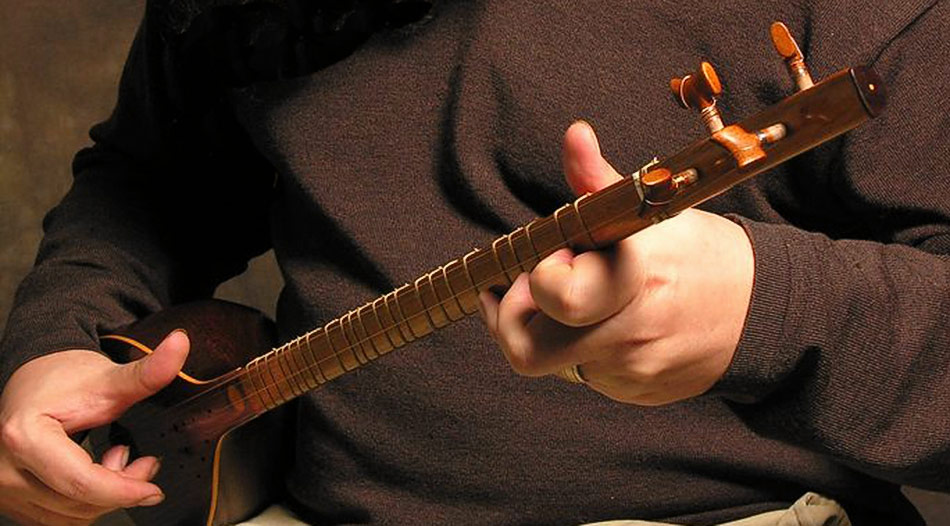
Established The body is carved from a single block of mulberry wood (tut) — small, pear-shaped, and without a separate soundboard or a true sound hole, though some instruments carry small decorative rosettes. The neck is long relative to the body, roughly 45–50 cm of playing length on a total scale length of about 65–67 cm, and carries 25–28 tied frets of gut, silk, or nylon. Established Unlike a guitar's fixed metal frets, these are loops tied around the neck that the player can slide — the setar's core mechanism for adjusting its intervals to the dastgah being performed. Four metal strings run in three courses (a paired top course plus two single lower strings) to four wooden tuning pegs.
Attested The setar is markedly quieter than the oud or cümbüş. That quietness is not a limitation the instrument suffers from — it reflects, and was shaped by, its traditional role in private and devotional settings rather than loud ensembles or outdoor performance.
The four standard tunings
Established Setar technique centers on four named tunings, distinguished by the interval relationships among the instrument's four strings (numbered 1–4, highest to lowest; strings 1–2 are the paired course):
| Tuning | Strings 1–2 / 3 / 4 | Associated with |
|---|---|---|
| Do-Sol (C–G) | C4 / C3 / G3 | The default tuning most instruction assumes |
| Re-Sol (D–G) | D4 / D3 / G3 | Segah, and some treatments of Chahargah |
| Do-Fa (C–F) | C4 / C3 / F3 | Certain modal contexts in Homayoun and Nava |
| Re-La (D–A) | D4 / D3 / A3 | Some approaches to Mahur and Rast-Panjgah |
Practice Do-Sol is the baseline most teachers and method books start from. The other three shift which drone relationships are available on the open strings to suit a specific dastgah — they are working alternatives selected for the music at hand, not fixed variants a player commits to permanently.
Playing technique
Established The setar is played without a plectrum: the right index fingernail strikes the strings directly, the hand resting at or near the body. Practice The signature technique is riz — rapid tremolo — which sustains a tone that would otherwise decay quickly on an instrument this small and this quiet; playing riz relaxed and even, without tension, takes years to develop. Established The left hand uses all four fingers within the fret framework, but the tied frets are deliberately not rigid: players bend pitch by pressing harder or rolling a finger, which is how the moteghayyer (mutable) pitches that distinguish one dastgah from another are actually produced in performance. Practice Repositioning frets between dastgahs is routine, but typically only two to four of the 25-plus frets move for any given change — the fixed intervals (octave, fifth, fourth) stay put, and only the frets carrying mutable pitches shift.
The setar in the radif tradition
Established The setar is one of the primary instruments through which the radif — the canonical repertoire of Persian classical music — is taught and performed. Attested A setar performance is organized around gradual modal exploration and tahrir (vocal-style ornamental turns rendered instrumentally) rather than around volume or technical display; the instrument's history as a private, contemplative practice shaped what its repertoire rewards and what a listener is meant to attend to.
Comparison with the tanbur
Established The setar's closest structural relative outside Persian music is the tanbur — the Turkish and Kurdish long-necked lute that likewise uses tied, moveable frets to carry microtonal pitch information — though the two instruments belong to separate theoretical systems (Persian dastgah versus Turkish makam) and are neither tuned nor played alike. Established Within Persian music, the setar's nearest relative is the tar: a larger, louder six-string lute played with a brass plectrum rather than a fingernail, drawing on the same dastgah repertoire but built for an ensemble presence the setar was never designed for. The oud and the cümbüş belong to a different technique family entirely — fretless and plectrum-played — where the setar's moveable-fret, fingernail-plucked approach has no real equivalent. See The Oud for that contrasting fretless tradition.
Sources
- Hormoz Farhat, The Dastgah Concept in Persian Music (Cambridge University Press, 1990)Textbook / peer-reviewed
- Jean During, The Art of Persian Music (Mage Publishers, 1991)Textbook / peer-reviewed
- Dariush Talai, A New Approach to the Theory of Persian Art Music (Mahoor Institute of Culture and Art, Tehran, 1993)Textbook / peer-reviewed
- Bruno Nettl, The Radif of Persian Music: Studies of Structure and Cultural Context (Elephant & Cat, 1987; rev. ed. 1992)Textbook / peer-reviewed
- Wikipedia contributors, "Setar"Secondary sourceView sourceRetrieved 2026-07-29
External Resources
Between Frets is not affiliated with or sponsored by any of the resources listed below. Links are provided for educational purposes only.
- Hossein AlizadehEstablished
YouTube Topic channel for one of Iran's leading classical musicians — two-time Grammy nominee, virtuoso of tar, setar, and shurangiz who recorded the entire radif for setar.
Essential listening for setar students. Alizadeh's radif recordings are canonical reference material for understanding dastgah performance on setar.
- Sahba Motallebi (SahbaTV)Established
First Iranian-American woman to win a Grammy Award. Over 1,000 free educational videos covering setar and tar technique, organized by skill level.
The most comprehensive free online setar lesson series available, with a structured multi-part curriculum for self-study at all levels.
- Hossein AlizadehEstablished
Spotify artist page with tar, setar, and shurangiz recordings spanning 40+ years, including radif recordings and composed works.
Stream the full breadth of Persian classical setar repertoire from its foremost living exponent.
Cross-cultural performance with Indian sitarist Kushal Das, exploring the shared modal roots between Persian setar and Indian sitar traditions.
Illuminates the setar's place in a broader family of long-necked lutes and demonstrates how Persian modal concepts relate to Indian raga.
- Amir Nojan (@amir.nojan.setar)Established
Bay Area-based setar player who studied with Dariush Talai and Mohammad Reza Lotfi. Performance clips and Persian classical music content.
Follow a diaspora performer for regular setar content that bridges Iranian homeland and international performance traditions.
First international Persian music online academy offering live online lessons in setar, tar, kamanche, and other instruments in both Persian and English.
Find structured one-on-one setar instruction from qualified teachers if self-study resources are not sufficient.
- Dariush TalaiAttested
Profile for master tar and setar player, musicologist, and 2019 Aga Khan Music Awards laureate. Produced the first educational video on tar and setar (1988, Paris).
Access recordings from a scholar-performer whose analytical approach to the radif and dastgah system has shaped modern setar pedagogy.
Related Articles
- InstrumentsThe Oud: History, Construction, and Playing TraditionsA guide to the oud — its deep history, bowl-back construction, fretless technique, and the distinct Turkish and Arabic traditions it anchors.
- Persian DastgahShur: The Foundational DastgahA guide to Shur, the most fundamental Persian dastgah — its scale structure, moteghayyer pitches, and central role in the radif tradition.
- PracticeUsing Meshk: From Theory to PracticeA friendly guide to meshk.app, the practice tool behind this site — which instruments and modes it covers, how to get sound out of it in three clicks, and how to use it alongside these articles.