The Tar: Construction, History, and the Persian Classical Tradition
The tar is the principal plucked string instrument of Persian classical music — a long-necked lute whose distinctive figure-8 body, lambskin soundboard, and brass plectrum technique give it a voice quite unlike anything in the Turkish or Arabic traditions. Where the setar is quiet and private, the tar projects: it was built for the ensemble, the concert stage, and the broadcast studio, and it has carried the radif tradition into all three.
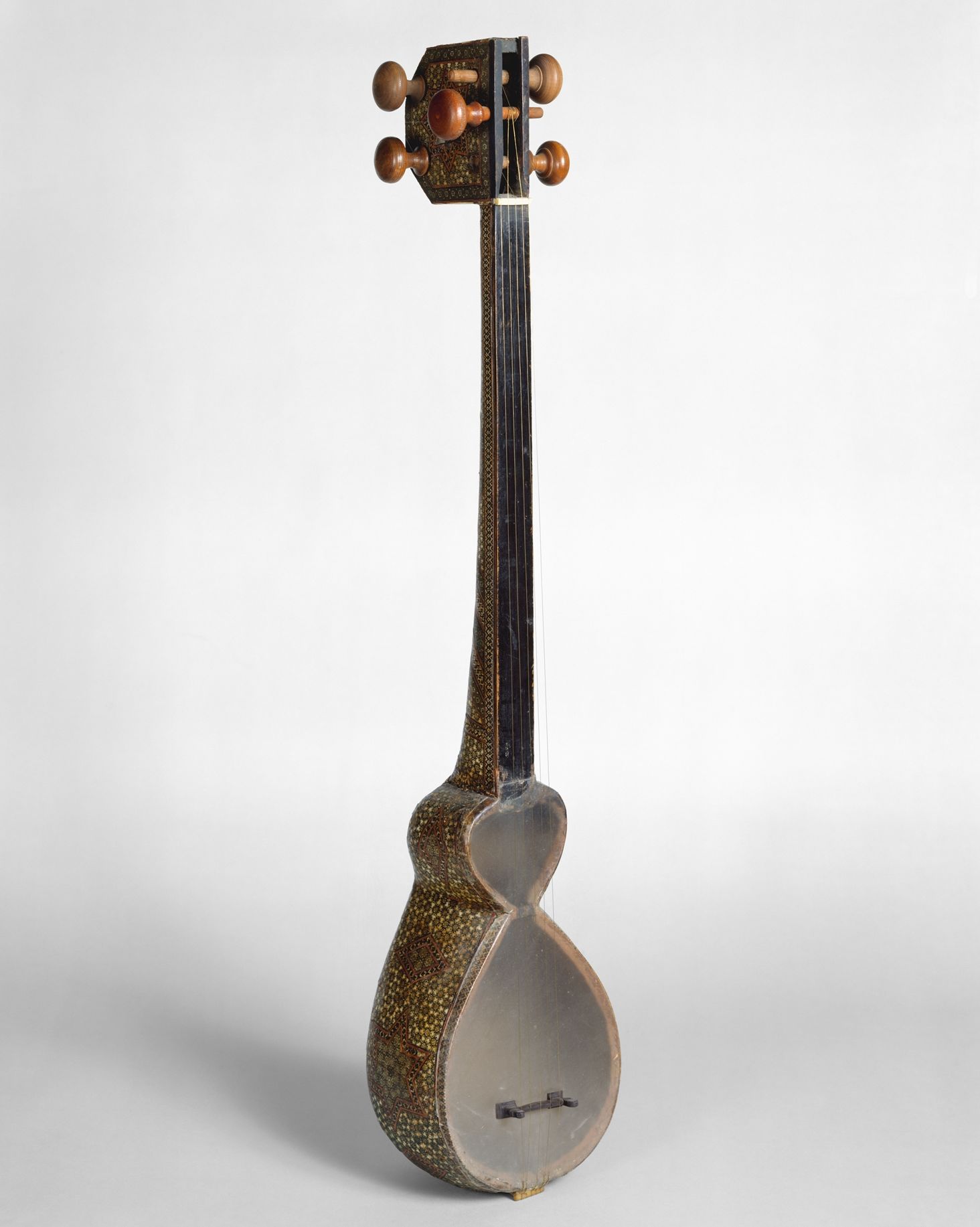 Courtesy of The Metropolitan Museum of Art, Public Domain
Etymology
Established The word tar is Persian for "string" — a root that appears across the region's instrument names. Se-tar is "three strings," do-tar is "two strings," chahar-tar is "four strings." The morpheme survives in lute names across Central and South Asia, reflecting the reach of Persian musical culture along the Silk Road.
Historical development
Attested The tar in its current form is relatively recent. It is often linked to the chahartar ("four-stringed"), an older long-necked lute documented in Persian poetry as early as the 14th century — though the Encyclopaedia Iranica describes the chahartar as a genuinely distinct, smaller instrument, and the relationship may be more complex than a simple line of descent. The tar was revised into approximately its present configuration — double-bowl body, five-string layout, playing technique — during the 18th century.
Attested The most important later modification was the addition of a sixth string by Darvish Khan (1872--1926), who doubled the bass C string. Both strings of this new bass pair became known as sim-e moshtaq, echoing an earlier innovation on the setar by the Sufi musician Moshtaq Ali Shah.
Established By the 20th century the tar had become, alongside the setar, one of the two primary instruments through which the radif is taught, performed, and transmitted.
Construction
Established The tar's body has a distinctive figure-8 or double-bowl shape, carved from a single block of mulberry wood (tut). The two connected chambers — a larger lower bout and a smaller upper bout — contribute to the instrument's resonant, sustained tone. The neck is long and narrow with a flat fingerboard, extending the total length to roughly 90--95 cm.
Established The soundboard is not wood: it is a thin membrane of lambskin stretched across the face of the larger bowl. This skin soundboard is central to the tar's character — it produces a warm but penetrating tone with a slight nasal quality that distinguishes the tar from wooden-topped instruments like the oud or the setar.
Established Six metal strings are arranged in three double courses. The first two courses (the higher-pitched "singing" courses) use plain steel strings tuned in unison within each pair. The third course uses wound copper strings tuned an octave apart — the lower of the two is a "flying" bass string that runs outside the main fingerboard over an extension of the nut, providing a drone and bass anchor. Six wooden tuning pegs of varying dimensions are set into the pegbox. The instrument's range spans approximately two and a half octaves.
Established The neck carries 25 to 28 moveable frets made of gut (or nylon). These are loops tied around the neck that the player can slide to adjust intervals for the dastgah being performed — the mechanism through which the tar produces the koron and sori inflections and the moteghayyer (mutable) tones that define each dastgah. See Fret Systems for a broader treatment of moveable versus fixed fretting.
Tuning
Established The tar's courses are tuned to intervallic relationships rather than fixed absolute pitches. Attested The most common baseline tuning, used for dastgah-e Shur and as a starting point for instruction, sets the courses to tonic--fifth--octave (approximately C4--G3--C3, first course highest). Practice As with the setar, the player retunes for different dastgahs, shifting open-string relationships to make specific drone intervals available. This retuning is routine, not unusual.
Playing technique
Established The tar is held across the lap, its body resting on the right thigh with the long neck angled upward to the left. It is played with a small brass plectrum called a mezrab (Persian: مضراب), roughly 3 cm long, held between the thumb and index finger of the right hand. The mezrab produces a bright, clear attack with more volume and projection than the setar's fingernail technique — this is the fundamental difference in sound between the two instruments.
Established Right-hand technique combines downstrokes and upstrokes in varied patterns, including rapid tremolo (riz) to sustain notes. Practice Controlling the mezrab's angle, pressure, and striking point is a primary focus of tar pedagogy; small changes produce large differences in timbre.
Established The left hand works within the moveable-fret framework. Pitch inflection — pressing harder to sharpen, rolling a finger for vibrato, bending a string laterally — is essential technique, not ornamentation; these micro-adjustments are how the moteghayyer (mutable) pitches are produced in performance. Attested Additional techniques include grace notes (tekyeh), slides, and controlled finger pressure to shade intonation.
The tar in the radif tradition
Established The radif — the canonical repertoire framework of Persian classical music — exists in versions specific to each instrument. The tar radif and the setar radif draw on the same gusheh (melodic models) and follow the same modal logic, but differ in technical realization: the tar's mezrab patterns and paired-string resonance shape how each gusheh sounds.
Established The tar radif traces its modern form to Mirza Abdollah (1843--1918) and his brother Aqa Hossein-Qoli (1853--1916), Qajar-era court musicians who assembled the most widely practiced version of the radif. Attested Aqa Hossein-Qoli traveled to Paris in the 1890s to make recordings — among the earliest documents of the tar radif as a living tradition.
Notable tar masters
Established The tar's modern lineage runs through a relatively compact chain of master-student relationships:
- Mirza Abdollah (1843--1918) — codified the radif that remains the standard pedagogical repertoire.
- Aqa Hossein-Qoli (1853--1916) — Mirza Abdollah's brother; among the first Persian musicians to make recordings (Paris, 1890s).
- Darvish Khan (1872--1926) — added the sixth string to the tar.
- Ali Akbar Shahnazi (1897--1985) — son of Aqa Hossein-Qoli; the first tar player to record the complete radif from memory.
- Jalil Shahnaz (1921--2013) — virtuoso soloist on the Golha radio program; widely regarded as one of the foremost tar players of the 20th century.
- Mohammad-Reza Lotfi (1947--2014) — co-founded the Shayda Ensemble; directed the Center for Preservation of Traditional Persian Music.
- Hossein Alizadeh (b. 1951) — composer and researcher; Grammy nominee (2007); inventor of the shurangiz.
- Dariush Talai (b. 1953) — recorded and published the complete radifs of Mirza Abdollah; taught at the Sorbonne and the University of Tehran.
Practice This lineage is not purely historical — it describes a living pedagogical chain. Contemporary tar students can trace their teacher's teacher back to Mirza Abdollah or Aqa Hossein-Qoli within a few generations.
The Persian tar and the Azerbaijani tar
Established The Azerbaijani (Caucasian) tar is a related but distinct instrument. Where the Persian tar has six strings in three courses over a lambskin soundboard and serves the dastgah/radif tradition, the Azerbaijani tar carries eleven strings in five paired courses plus a bass drone, uses ox pericardium for its soundboard, and belongs to the mugham tradition. Attested The Azerbaijani variant was developed from the Persian tar around 1870 by the musician Sadigjan (Mirza Sadiq Asad, 1846--1902), who increased the string count and modified the playing position to be held against the chest. Established In 2012, the Azerbaijani tar's craftsmanship and performance art was added to UNESCO's Intangible Cultural Heritage list. Practice For students: these are functionally different instruments. Method books and repertoire do not transfer between them.
Comparison with the setar
Established The tar and setar are complementary instruments within the same tradition — two paths through the same radif repertoire. Both use moveable gut frets to produce the same microtonal intervals. The differences are in scale: the tar has six strings in three double courses and a lambskin soundboard struck with a brass mezrab, giving it the volume for ensemble and concert settings. The setar has four individual strings on a smaller mulberry body, played with the fingernail, suited to solo performance and intimate gatherings. The choice between them is partly contextual and partly a matter of the musician's temperament and training lineage.
Sources
- Hormoz Farhat, The Dastgah Concept in Persian Music (Cambridge University Press, 1990)Textbook / peer-reviewed
- Jean During, The Art of Persian Music (Mage Publishers, 1991)Textbook / peer-reviewed
- Dariush Talai, A New Approach to the Theory of Persian Art Music (Mahoor Institute of Culture and Art, Tehran, 1993)Textbook / peer-reviewed
- Encyclopaedia Iranica, s.v. "Darvish Khan," "Chahartar"Textbook / peer-reviewedView sourceRetrieved 2026-07-30
- Wikipedia contributors, "Tar (string instrument)"Secondary sourceView sourceRetrieved 2026-07-30
External Resources
Between Frets is not affiliated with or sponsored by any of the resources listed below. Links are provided for educational purposes only.
- Hamid MotebassemEstablished
YouTube channel of the classical Persian tar and setar player who founded the Dastan Ensemble (1991), winner of Le Monde's 'Musical Shock' title.
Watch a master tar performer whose ensemble work defines modern Persian classical performance practice.
- Dariush TalaiEstablished
Official channel of the master tar and setar player, musicologist, and 2019 Aga Khan Music Awards laureate. Studied with Ali Akbar Shahnazi and Nur Ali Borumand.
Pedagogically essential — Talai produced the first educational video on tar and setar (1988) and is a major scholarly authority on Persian classical music.
- Dariush PirniakanEstablished
Spotify recordings of the tar and setar player who studied under Ali-Akbar Shahnazi and collaborated with Mohammad Reza Shajarian since 1979.
Listen to studio-quality tar performances from a master whose three-decade collaboration with Shajarian produced some of the most important Persian classical recordings.
Overview article covering tar history, construction (double-bowl body, lambskin soundboard), and musical role in Persian classical tradition.
Accessible English-language introduction to tar organology for readers wanting a concise overview alongside this article.
Online tar lessons for beginners through the first international Persian music online academy, taught by Parisa Kashefi with 25 years of teaching experience.
Find structured one-on-one tar instruction from a qualified teacher who studied with Fariborz Azizi, Dariush Pirniakan, and Hossein Alizadeh.
- Hossein AlizadehAttested
Profile for one of the most important living Persian classical musicians, with tar, setar, and shurangiz recordings spanning decades.
Access archival and rare tar recordings that may not be available on mainstream streaming platforms.
Educational video introducing the tar instrument with Mohammad Sahraei, covering construction, sound, and playing technique.
A clear, accessible introduction to the tar for a general audience unfamiliar with Persian instruments.
Academic paper comparing historical tuning systems across tanbur, oud, tar, and saz
Primary source for cross-instrument tuning analysis — directly compares the tuning systems of instruments covered on this site
Related Articles
- InstrumentsThe Setar: Construction, Tuning, and the Persian Classical TraditionThe Persian long-necked lute of the dastgah tradition — its three-to-four-string history, mulberry-wood construction, four standard tunings, and quiet, fingernail-plucked technique.
- InstrumentsThe Oud: History, Construction, and Playing TraditionsA guide to the oud — its deep history, bowl-back construction, fretless technique, and the distinct Turkish and Arabic traditions it anchors.
- Persian DastgahThe Dastgah System: An Introduction to Persian Classical MusicAn overview of the twelve-mode dastgah system — seven primary dastgahs, five satellite avazes, and the radif tradition that defines Persian classical music.