Sound Production Methods: Plucked, Bowed, Struck, and Blown
Every instrument in the makam and dastgah traditions produces sound in one of four fundamental ways: plucking strings, bowing strings, striking strings or membranes, or blowing air through a tube. The method of sound production determines not just what the instrument sounds like but what it can do musically — how it sustains, how it ornaments, how precisely it controls pitch, and what role it plays in the ensemble.
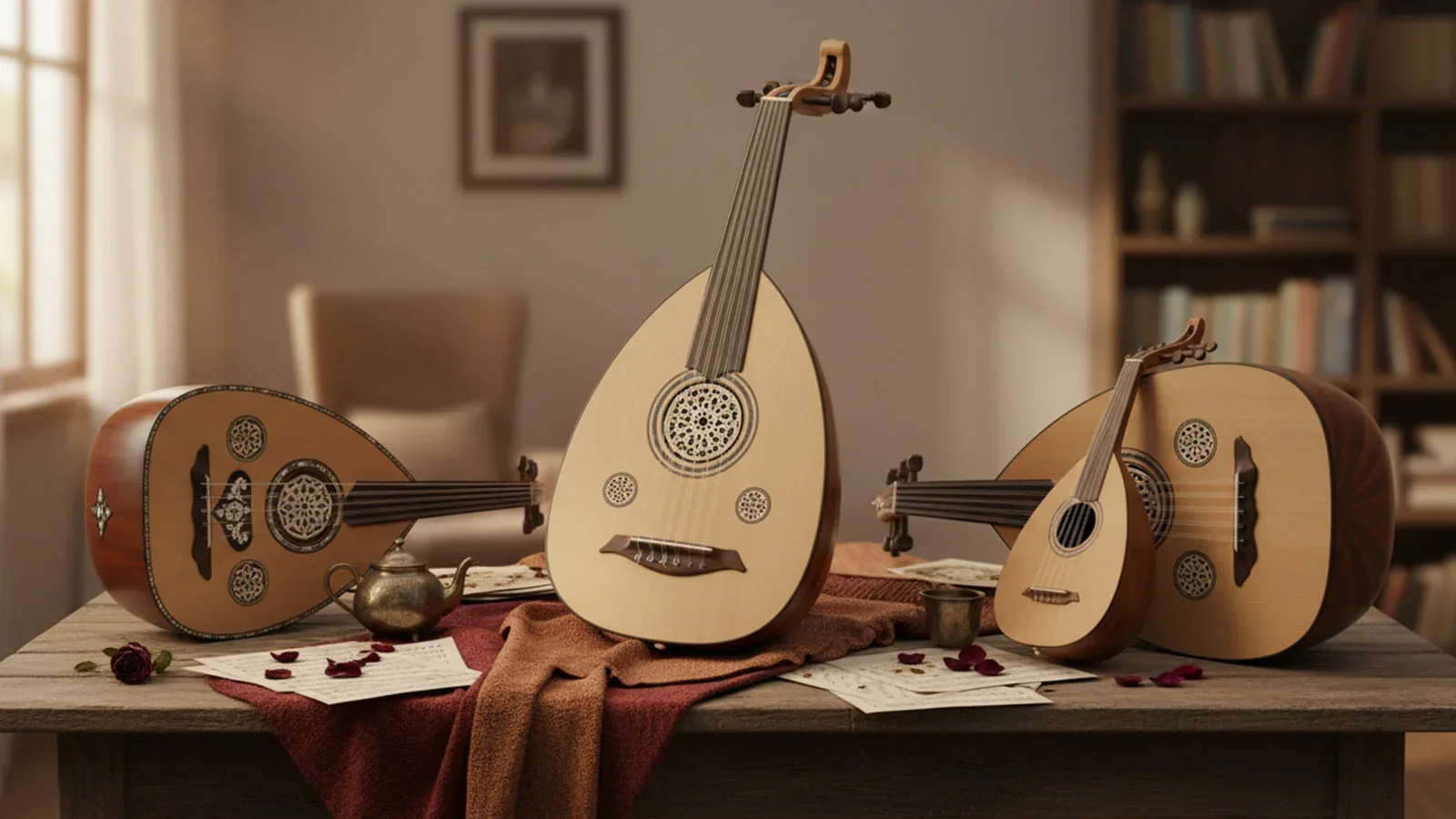
Plucked instruments
Established Plucked instruments — oud, tanbur, setar, tar, bağlama, qanun — produce sound by pulling a string sideways and releasing it. The string vibrates freely, producing a sharp attack followed by a gradual decay. The player can control the initial volume (by how far the string is pulled) but has limited control over the sound once the string is released.
Practice Characteristics of plucked sound:
- Clear attack: each note has a defined beginning, making melodic lines precise and rhythmically articulate
- Decaying sustain: sound fades after the initial pluck, which limits how long a note can sing
- Tremolo as sustain technique: rapid repeated plucking (tremolo) compensates for the natural decay, creating the illusion of sustained tone — essential on tanbur and setar
- Pitch precision: fretted plucked instruments (tanbur, setar, bağlama) produce precise pitches determined by fret placement; fretless plucked instruments (oud) require the player to find each pitch by ear
Bowed instruments
Established Bowed instruments — kemençe, kamanche, violin (as used in Turkish/Arabic/Persian music) — produce sound by drawing a bow across the string, creating continuous vibration as long as the bow moves. This gives bowed instruments the ability to sustain notes indefinitely, a fundamental advantage over plucked instruments.
Practice Characteristics of bowed sound:
- Sustained tone: a bowed note can last as long as the bow stroke, enabling long melodic phrases without the tremolo technique plucked instruments require
- Continuous dynamic control: the player can vary volume moment to moment by changing bow pressure and speed
- Seamless pitch connection: sliding between pitches (portamento) is natural on bowed instruments, enabling the smooth melodic connections that characterize makam and dastgah performance
- Vibrato: oscillating pitch through left-hand movement adds warmth and expression
Struck instruments
Established Struck instruments include both strings struck with mallets (santur) and membranes struck with hands or sticks (kudüm, daf, tombak, darbuka). The common factor is an impulsive excitation — a single impact that sets the vibrating element in motion.
Practice Struck strings (santur) share the plucked instrument's decaying sustain but with a different attack character — brighter, more percussive, with more high- frequency content at the moment of impact. The santur's tremolo (riz) technique, like the tanbur's tremolo, creates sustained tone from rapidly repeated impacts.
Practice Struck membranes (percussion) produce the rhythmic framework of the ensemble. The distinction between düm (bass) and tek (treble) strokes creates a two-tone vocabulary from which all usul and iqa' patterns are built.
Blown instruments
Established Blown instruments — ney, zurna, mey — produce sound through vibrating air columns. The ney produces sound by directing an air stream across the rim of an open tube. The zurna and mey use double reeds — two thin pieces of cane that vibrate against each other when the player blows between them.
Practice Characteristics of blown sound:
- Continuous sustain: like bowed instruments, wind instruments sustain as long as the player has breath (or uses circular breathing)
- Breath-shaped phrasing: the natural inhale-exhale cycle imposes a phrasing structure that mirrors vocal music
- Limited polyphony: wind instruments play one line at a time, making them purely melodic voices
- Timbral variety: overblowing (increasing air pressure) produces higher octaves with different timbral character
How sound production shapes ensemble roles
Practice In both Turkish fasıl and Persian classical ensembles, instruments are chosen to provide complementary sound types:
| Role | Method | Instruments |
|---|---|---|
| Sustained melody | Bowed / Blown | Kemençe, kamanche, ney |
| Articulate melody | Plucked | Tanbur, tar, setar |
| Bright texture | Struck strings | Santur, qanun |
| Rhythmic framework | Struck membrane | Kudüm, tombak, daf |
Practice The combination ensures that the ensemble can produce both sustained tones (for long melodic phrases) and precise attacks (for rhythmic clarity), with percussion providing the temporal framework that holds everything together.
Implications for makam and dastgah
Practice Sound production method affects how each instrument handles the microtonal inflections central to makam and dastgah:
- Fretted plucked instruments produce the pitches their frets define — microtonal flexibility comes from fret placement, string bending, and vibrato
- Fretless plucked instruments (oud) leave pitch entirely to the player's ear and finger placement
- Bowed instruments have unlimited pitch flexibility, making them ideal for the subtle pitch inflections of moteghayyer and the smooth melodic connections of seyir
- Blown instruments (ney) control pitch through finger placement and breath pressure, allowing fine microtonal adjustment
Where to go from here
A plucked instrument: Oud. A bowed instrument: Kemençe. A struck instrument: Santur. A blown instrument: Ney. String configurations: String Courses. Tuning these instruments: Practical Tuning Methods.
Sources
- Karl Signell, Makam: Modal Practice in Turkish Art Music (Asian Music Publications, 1977)Textbook / peer-reviewed
- Jean During, The Art of Persian Music (Mage Publishers, 1991)Textbook / peer-reviewed
External Resources
Between Frets is not affiliated with or sponsored by any of the resources listed below. Links are provided for educational purposes only.
Close-up demonstration of bowed kemence technique — nail-stopping, instrument rotation, and the transparent tone produced by light bow pressure on metal strings.
The clearest available video comparison of bowing technique on a traditional Middle Eastern instrument versus Western violin approach.
English-language introduction to ney sound production — the demanding embouchure where air is directed at the reed's edge, the role of breath control, and the instrument's three-octave range.
The best available demonstration of blown sound production on a Middle Eastern instrument, clearly contrasting with Western flute technique.
- Faramarz Payvar — Santur & TombakEstablished
Album pairing the santur (struck with light wooden mezrab mallets) and tombak (struck with bare hands), demonstrating two distinct approaches to percussion sound production.
Hear the sonic contrast between mallet-struck dulcimer strings and hand-struck drum membrane — two fundamentally different 'struck' sound production methods side by side.
- Craftsmanship Magazine — The Reed ArtistEstablished
In-depth article and photo essay documenting ney craftsmanship — reed selection, straightening, node clearing, tone hole positioning, and mouthpiece shaping.
Understand how the physical construction of the ney reed directly determines its sound production characteristics — material and craftsmanship shape the instrument's voice.
- Goksel Baktagir — Kanun EtudesEstablished
Official channel of the Turkish kanun virtuoso featuring etude videos that demonstrate the plucking technique using metal plectra (parmaklik) attached to the fingers.
See the distinctive plucking mechanism of the qanun — metal finger-plectra produce a bright, harp-like attack quite different from the oud's single plectrum or the setar's fingernail.
- Murat Aydemir — Tanbur TaksimiEstablished
Tanbur improvisation demonstrating the delicate plectrum (mizrap) technique — the light, controlled brush stroke that produces the tanbur's characteristic transparent, bell-like tone.
Hear how the tanbur's unique plectrum technique produces a fundamentally different plucked sound from the oud — lighter, more sustained, with prominent sympathetic resonance.
Related Articles
- InstrumentsThe Oud: History, Construction, and Playing TraditionsA guide to the oud — its deep history, bowl-back construction, fretless technique, and the distinct Turkish and Arabic traditions it anchors.
- InstrumentsThe Ney: Construction, Technique, and TraditionA guide to the ney — the end-blown reed flute central to Turkish makam and Persian dastgah traditions, its demanding embouchure, and its place in Ottoman and Mevlevi musical practice.
- InstrumentsThe Kemençe: Classical and Black Sea TraditionsTwo instruments, one name — the pear-shaped classical kemençe of Ottoman court music and the narrow-bodied Karadeniz kemençesi of the Black Sea coast, their construction, playing technique, and distinct musical roles.