The Ney: Construction, Technique, and Tradition
The ney is an end-blown reed flute found across Turkish, Persian, Arabic, and Central Asian musical traditions. Unlike transverse flutes, it is held vertically and blown from the top edge. It is one of the oldest musical instruments still in active use, with examples dating back over 4,500 years to ancient Egypt.
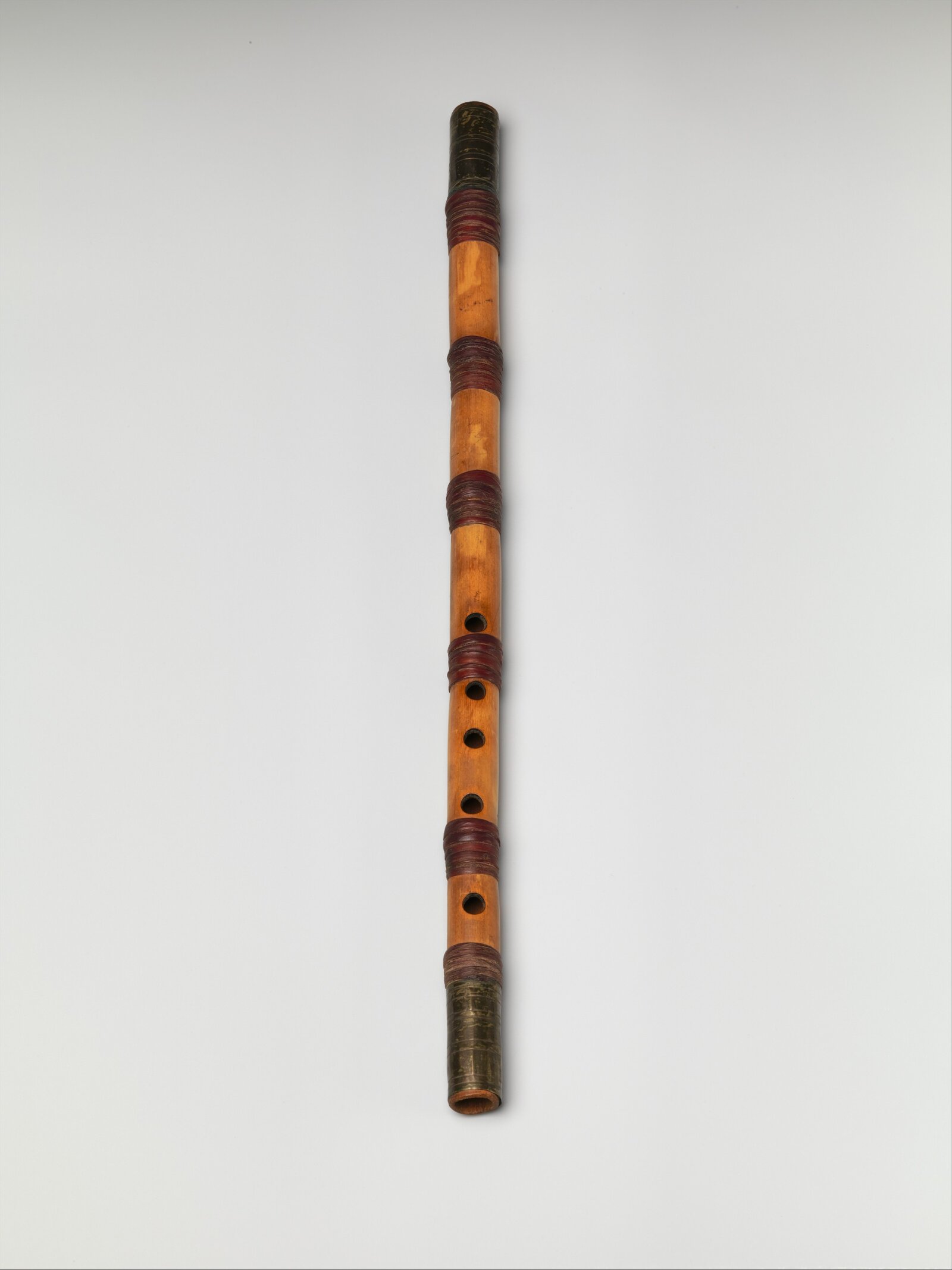 Courtesy of The Metropolitan Museum of Art, Public Domain
Construction
Established The ney is made from a length of Arundo donax (giant reed, called kamış in Turkish), a hollow-stemmed plant native to the Greater Middle East and Mediterranean basin. The same species provides reeds for Western woodwind instruments (clarinets, oboes, bassoons), but for the ney the entire stem segment becomes the instrument body rather than just a vibrating reed.
Attested A finished ney is a section of cane that includes nine nodes, producing eight segments between them. The finger holes are burned or drilled through the cane wall at specific positions between these nodes. The nodes themselves serve as structural reinforcement, preventing the thin-walled cane from cracking. The bore is naturally cylindrical, and the interior node membranes are opened to allow air to flow through the full length.
Established Modern variants occasionally substitute metal or plastic tubing for the traditional reed, but most players in the Turkish and Persian classical traditions consider genuine cane essential for the instrument's tonal character.
Turkish ney vs. Persian ney
The two principal traditions use instruments that differ in construction, hole configuration, and most importantly, embouchure.
| Turkish ney | Persian ney | |
|---|---|---|
| Finger holes | 7 (6 front, 1 thumb) | 6 (5 front, 1 thumb) |
| Mouthpiece | Başpare (cap of horn, bone, brass, or plastic) | None — blown directly on the open reed edge |
| Embouchure | Lips rest against the başpare, air directed into the bore | Lips placed directly on the rim of the cane; some players use a gap between the front teeth |
| Naming | Turkish: ney | Persian: ney or nay |
| Primary modal system | Turkish makam (53-comma system) | Persian dastgah |
Established The Turkish ney's başpare is a small cap fitted over the blowing end of the instrument. It protects the cane from moisture damage and provides a consistent surface for the embouchure. The başpare does not function as a Western-style mouthpiece with a reed — it is simply a shaped rim against which the player directs the airstream.
Established The Persian ney has no mouthpiece at all. The player blows directly against the open, beveled top edge of the cane. Some Persian players position the instrument between the two front teeth, using the gap as a channel for the airstream. This technique is particular to the Persian tradition.
Playing technique
Established The ney has a reputation as one of the most difficult instruments to begin. Unlike a Western recorder or flute, which produces sound relatively easily, the ney requires the player to develop a specific embouchure just to produce a stable tone. Beginners often spend weeks producing only breathy, unfocused sound before achieving consistent pitch.
Established A skilled ney player — called a neyzen (Turkish) or nayzān (Persian) — can reach more than three octaves by controlling airstream speed, angle, and lip pressure. The lowest register uses a gentle, broad airstream; the upper registers require progressively tighter, faster air. Overblowing produces the second and third octaves.
Established Microtonal inflection — essential for both makam and dastgah performance — is achieved through three techniques: partial covering of finger holes, changes in embouchure pressure and angle, and adjustments to the instrument's overall position relative to the lips. This gives the ney continuous pitch flexibility across its range, rather than the fixed steps of a keyed instrument.
Practice Because of the ney's sensitivity to reed quality, bore irregularities, and atmospheric conditions, players typically maintain several instruments in different sizes to cover different pitch ranges and to have alternatives when a particular reed is not responding well.
Sizes and tuning
Attested Turkish neys are made in a range of sizes, each named after the perde (pitch position) that its lowest note produces when all holes are closed. Common sizes include the bolahenk (lowest, longest), davud, şah, mansur, kız, müstahsen, and sipürde (highest, shortest). The mansur is often considered the standard teaching size.
Uncertain The precise number of standard sizes and their exact naming conventions vary between sources and pedagogical lineages. Different makers and conservatory traditions recognize slightly different sets. Treat specific lists of "the twelve sizes of ney" or similar definitive catalogs with caution unless citing a specific authority.
Established Unlike fixed-pitch instruments, the ney's tuning is flexible within each size. A neyzen adjusts intonation in real time through embouchure and finger technique, conforming to the pitch requirements of whatever makam is being performed. The instrument does not impose a fixed temperament.
The ney in Ottoman classical music
Established The ney was one of the instruments in continuous use throughout the history of Ottoman classical music. The musicologist Çinuçen Tanrıkorur identified it among 18 instruments common in classical circles, alongside the tanbur, oud, kanun, rebab, and others. While certain instruments like the çeng (harp) fell out of use over the centuries, the ney, tanbur, and kanun maintained their positions.
Attested In the indoor fasıl (suite) ensemble, the ney was typically the only sustained wind instrument. Other wind instruments existed in Ottoman military and folk traditions (the zurna, for example), but these belonged to different performance contexts. The ney's role in the chamber music tradition gave it a distinct status among classical instruments.
The ney in Mevlevi tradition
Established The ney holds a specific ceremonial function in the Mevlevi order (the Sufi order founded on the teachings of Jalal al-Din Rumi). In the sema ceremony, the mutrip (musical ensemble) consists of four principal instruments: ney, kudüm (small kettledrums), rebab (bowed lute), and halile (small cymbals). The ney provides the primary melodic voice.
Established During the sema, a solo ney taksim (improvisation) follows the Naat-i Sharif (a sung eulogy to the Prophet Muhammad). This taksim is understood within the tradition as symbolizing the Divine breath that gives life to creation.
Established Rumi's Masnavi (13th century) opens with an extended metaphor centered on the reed flute: "Hearken to the reed-flute, how it discourses / When complaining of the pains of separation; / Ever since they tore me from my osier-bed, / My plaintive notes have moved men and women to tears" (E. H. Whinfield translation, 1898). This literary association has deeply shaped the instrument's cultural identity, but it is worth noting that the ney's musical role in Ottoman tradition extends well beyond the Mevlevi context. It was a standard instrument of secular court music, not exclusively a Sufi instrument.
Notable neyzen
Established Neyzen Tevfik (Tevfik Kolaylı, 1879--1953) was a virtuoso ney player and well-known satirical poet. He composed taksims and saz semais in makams including Nihavent and Şehnazbuselik. He remains one of the best-known cultural figures in Turkish music history.
Established Niyazi Sayın (1927--2025) was widely regarded as the most important ney player in Turkish classical music. He performed extensively with tanbur player Necdet Yaşar, and their duet recordings (including Masters of Turkish Music, Kalan Müzik, 2006) are considered reference recordings of the tradition. He was also an ebru (marbling) artist and photographer.
Established Kudsi Erguner (b. 1952) is a leading contemporary neyzen and a recognized authority on Mevlevi Sufi music. He learned from his father Ulvi Erguner and participated in sema ceremonies as a young musician. After relocating to Paris, he established the Mevlana Institute for the study and teaching of classical Sufi music. He has collaborated with Peter Gabriel and Jean Michel Jarre, among others, and received the UNESCO Artist for Peace designation in 2016.
Sources
- New Grove Dictionary of Music and Musicians, s.v. "Nāy"Textbook / peer-reviewed
- Karl Signell, Makam: Modal Practice in Turkish Art Music (Asian Music Publications, 1977)Textbook / peer-reviewed
- Wikipedia contributors, "Ney"Secondary sourceView sourceRetrieved 2026-07-30
- Wikipedia contributors, "Ottoman music"Secondary sourceView sourceRetrieved 2026-07-30
- Wikipedia contributors, "Mevlevi Order"Secondary sourceView sourceRetrieved 2026-07-30
External Resources
Between Frets is not affiliated with or sponsored by any of the resources listed below. Links are provided for educational purposes only.
High-quality English-language introduction to the Turkish ney featuring ney player Cengiz Arslanpay, exploring construction, sound production, embouchure technique, and musical context.
The single best starting point for English-speaking audiences to understand the ney — accessible, well-produced, and technically accurate.
- Kudsi ErgunerEstablished
One of the most internationally recognized Turkish ney masters. Born into the Erguner family lineage of neyzen, UNESCO Artist for Peace. Over 30 albums on labels including UNESCO Collections and ECM.
Stream the most comprehensive collection of Turkish ney recordings available, from a master who represents the Mevlevi Sufi tradition at its highest level.
- The Persian Ney (persianney.com)Established
Comprehensive website covering the Persian ney: playing technique, notable players, history, and a detailed technique page explaining the distinct Persian embouchure.
The most thorough English-language reference for the Persian ney tradition, complementing this article's coverage of the Turkish tradition.
- Kudsi Erguner — Official ChannelEstablished
Official YouTube channel of master neyzen Kudsi Erguner, featuring taksim performances in various makams, reed selection, and Mevlevi Sufi music.
Watch a living master demonstrate ney technique across multiple makams, including the rarely filmed process of selecting and preparing ney reeds.
- Burcu Karadag (@burcukaradag)Established
ITU Turkish Music State Conservatory graduate (28K followers). Posts include ney performances, teaching content, ethno-jazz ney pieces, and live online lesson announcements.
Follow the most-followed ney player on Instagram for regular performance clips and access to online ney lessons.
- Hossein Omoumi — Official WebsiteEstablished
Personal website of master Persian ney player Hossein Omoumi, Maseeh Professor in Persian Performing Arts at UC Irvine. Includes biography, innovations page, and academic work.
The innovations page documents this master's contributions to the Persian ney instrument itself — essential context for the Persian ney tradition.
- Kudsi ErgunerAttested
SoundCloud profile for the Turkish ney master, musicologist, and educator of Ottoman and Mevlevi music.
Access rare ney recordings, live concert material, and performances that may not be available on mainstream streaming platforms.
Related Articles
- InstrumentsThe Tanbur: The Instrument That Maps the CommasThe Ottoman long-necked lute whose frets physically embody the Holdrian comma system — its ancient lineage, exacting construction, mızrap technique, and central role in Turkish court music.
- InstrumentsThe Oud: History, Construction, and Playing TraditionsA guide to the oud — its deep history, bowl-back construction, fretless technique, and the distinct Turkish and Arabic traditions it anchors.
- HistoryOttoman Court Music: A Living TraditionThe rise, flourishing, and near-destruction of Ottoman classical music — from the Enderun palace school and the meşk tradition to the Mehter military band, the great composers, and the Republic-era suppression that nearly silenced it all.