The Kemençe: Classical and Black Sea Traditions
The name kemençe refers to two distinct bowed instruments with different bodies, different techniques, and different musical worlds. The classical kemençe (armudî kemençe) is a pear-shaped, three-stringed instrument of Ottoman court music. The Black Sea kemençe (Karadeniz kemençesi) is a narrow, boat-shaped three-stringed fiddle of the northeastern Turkish coast. Understanding which instrument is meant requires context.
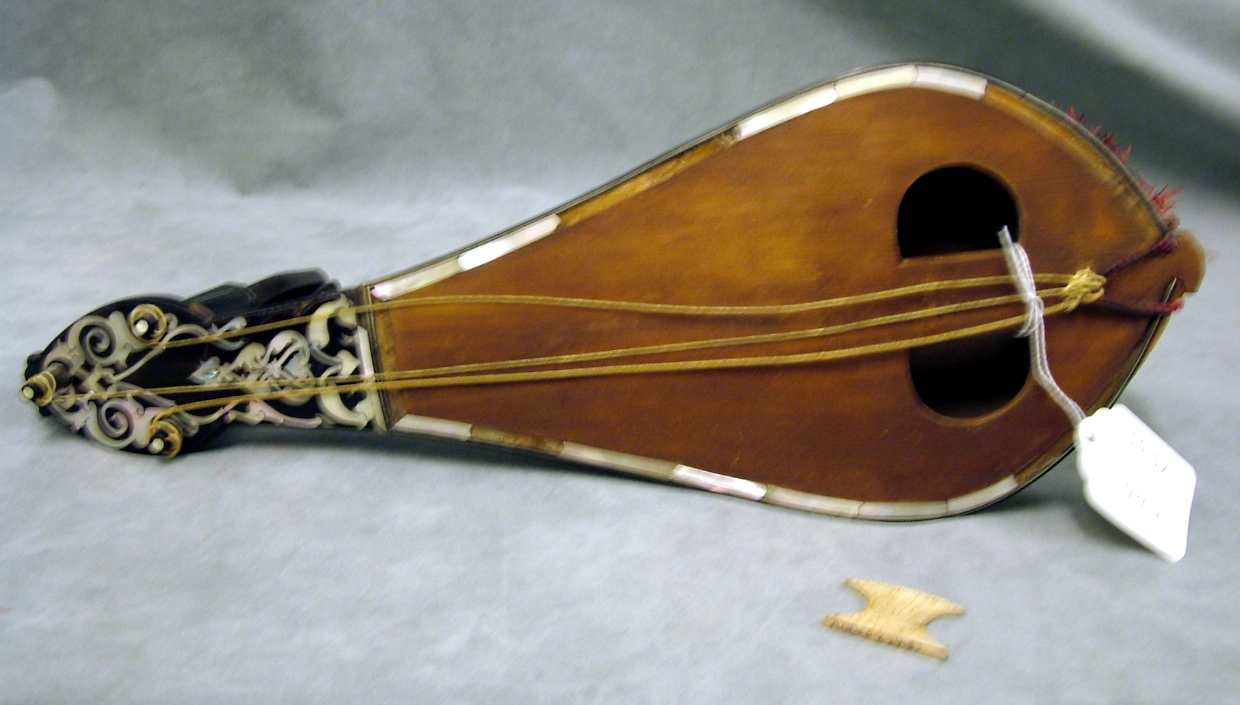 Courtesy of The Metropolitan Museum of Art, Public Domain
The classical kemençe
Established The classical kemençe, also called the armudî ("pear-shaped") kemençe, is a small bowed lute with a pear-shaped body, three strings, and a playing technique that distinguishes it from all Western bowed instruments: the strings are stopped not by pressing fingertips against a fingerboard but by touching them laterally with the fingernails.
Attested This nail-stopping technique produces a distinctive, slightly nasal timbre with an ethereal quality that sets the kemençe apart from the violin (which replaced it in many contexts during the 19th century). The nails touch the strings from the side rather than pressing them down, creating a lighter contact that allows for rapid ornamental passages and characteristic sliding between pitches.
Established The instrument is held vertically, resting on the player's knee, and bowed with a short, arched bow. The three strings are typically tuned in fourths or fifths, though tuning varies by performer and context.
Attested The classical kemençe has a lineage that connects it to the Byzantine lyra — a medieval bowed instrument documented in Byzantine sources from the 9th century onward. The Greek name politiki lyra ("lyra of the City," i.e., Constantinople/Istanbul) reflects this historical connection. The instrument was shared across the Greek and Turkish musical cultures of Istanbul.
The Black Sea kemençe
Established The Karadeniz kemençesi is a physically different instrument: narrow-bodied, roughly rectangular or boat-shaped, with three strings tuned in fourths. It is smaller than the classical kemençe and produces a brighter, more penetrating sound suited to the outdoor dance music of the Black Sea coast.
Attested The Black Sea kemençe is the primary melodic instrument of the horon — the energetic circle dance tradition of the Pontic region. Its repertoire is folk rather than classical, built on the asymmetric rhythms (7/8, 9/8) and modal patterns of northeastern Anatolia rather than the makam system of the court tradition.
Practice The two kemençes share a name and the general principle of bowed strings, but they occupy completely different musical contexts. A classical kemençe player and a Black Sea kemençe player use different techniques, play different repertoire, and participate in different musical traditions.
The classical kemençe in Ottoman music
Attested Feldman documents the classical kemençe as a standard member of the Ottoman court ensemble alongside the tanbur, ney, and kudüm. Its role was both melodic and ornamental — the instrument's agility and distinctive timbre made it suited to the elaborate melodic lines of peşrev and saz semaisi performances.
Attested The instrument experienced a decline in the late Ottoman and early Republican periods as the Western violin was adopted by Turkish classical musicians. The violin offered greater volume, a wider range, and compatibility with Western performance contexts. By the mid-20th century, the classical kemençe had become rare in active performance.
Attested A revival beginning in the late 20th century brought the instrument back into concert performance and conservatory teaching. Musicians like İhsan Özgen championed the classical kemençe, demonstrating that its unique timbral qualities — especially the nail-stopped ornamental technique — offered something the violin could not replicate.
Construction
Attested The classical kemençe body is carved from a single block of wood (traditionally juniper, plum, or mulberry) into a pear shape. The soundboard is a thin wooden plate, not a skin membrane. Three gut or metal strings run from a tailpiece over a small bridge to lateral tuning pegs. The instrument is small enough to be held easily against the knee, typically 40–45 cm in total length.
Attested The Black Sea kemençe is even smaller, typically 30–40 cm, with a narrower body and a more angular shape. Its construction is simpler, reflecting its folk origins — the instrument was traditionally handmade by players or village craftsmen rather than by specialist luthiers.
Playing technique
Practice For students approaching the classical kemençe:
- Nail stopping is the defining technique. The left-hand fingernails contact the strings from the side, not the fingerboard from above. This requires growing and maintaining the nails at a specific length.
- Bow technique uses a short bow with less pressure than a violin bow, producing the instrument's characteristic light, transparent sound.
- Ornamental facility is a strength — the nail technique allows for rapid trills, slides, and grace notes that are idiomatic to the instrument.
- Volume is limited compared to the violin, making the kemençe better suited to chamber performance than to large concert halls.
Where to go from here
The instrument it shares the stage with: Tanbur. The wind instrument of the court ensemble: Ney. The plucked alternative: Oud. The court tradition it served: Ottoman Court Music. Its role in Sufi ceremony: Mevlevi and Bektashi Traditions.
Sources
- Walter Feldman, Music of the Ottoman Court (Intercultural Music Studies 10, VWB, 1996)Textbook / peer-reviewed
- Karl Signell, Makam: Modal Practice in Turkish Art Music (Asian Music Publications, 1977)Textbook / peer-reviewed
- Wikipedia contributors, 'Kemençe'Secondary sourceView sourceRetrieved 2026-07-30
External Resources
Between Frets is not affiliated with or sponsored by any of the resources listed below. Links are provided for educational purposes only.
- Derya TurkanEstablished
Young master of classical Turkish kemence, ITU Conservatory graduate. Albums include Istanbul Kemencesi (2020), Silence (2021), and the Ahenk series with tanbur player Murat Aydemir.
Essential listening for developing ear for the classical kemence's distinctive transparent tone and nail-stopping technique.
Video where Derya Turkan demonstrates the kemence for composers, showing the instrument's capabilities, range, and techniques in close-up.
The best available English-accessible video for understanding classical kemence technique, tone production, and the nail-stopping method.
- Ihsan Ozgen — Kemence ile Makam SeyirleriEstablished
Demonstrations of makam melodic paths (seyir) on the kemence by Ihsan Ozgen, who applied violin/cello techniques to kemence playing and taught at Istanbul Conservatory from 1976.
Directly demonstrates how each makam unfolds on the kemence — invaluable for understanding the relationship between seyir theory and bowed instrument practice.
- Derya Turkan (@deryaturkan)Established
Active Instagram presence (21K followers) with posts about kemence performance, masterclasses, and musical life between Istanbul and Berlin. Aga Khan Music Awards 2025 nominee.
Follow the leading living classical kemence player for regular performance clips, teaching content, and concert announcements.
- Turkish Music Portal — KemenceEstablished
Reference entry explaining that kemence is the common name for two very different instruments: the classical kemence of Ottoman court music and the Black Sea kemence of north Anatolian folk music.
Essential for understanding the dual identity of the kemence — the most common source of confusion for students encountering the instrument.
Video showing the kemence driving the horon, the famous folk dance of Turkey's Black Sea coast, demonstrating the Karadeniz kemencesi in its primary performance context.
See the Black Sea kemence in action — its energetic, rhythmic playing style contrasts sharply with the meditative classical kemence tradition.
- Derya TurkanAttested
SoundCloud profile for the leading living classical kemence player, featuring Turkish makam performances.
Access kemence recordings that may include live concert material and rare tracks not available on mainstream streaming platforms.
Related Articles
- InstrumentsThe Oud: History, Construction, and Playing TraditionsA guide to the oud — its deep history, bowl-back construction, fretless technique, and the distinct Turkish and Arabic traditions it anchors.
- InstrumentsThe Ney: Construction, Technique, and TraditionA guide to the ney — the end-blown reed flute central to Turkish makam and Persian dastgah traditions, its demanding embouchure, and its place in Ottoman and Mevlevi musical practice.
- InstrumentsThe Tanbur: The Instrument That Maps the CommasThe Ottoman long-necked lute whose frets physically embody the Holdrian comma system — its ancient lineage, exacting construction, mızrap technique, and central role in Turkish court music.