The Santur: Hammered Dulcimer of Persian and Turkish Music
The santur is a trapezoidal hammered dulcimer: its strings are struck with light wooden mallets (mezrab) rather than plucked or bowed. This fundamental difference in sound production gives the santur a percussive attack, rapid decay, and shimmering sustain that make it instantly recognizable in Persian classical music, where it has been a core ensemble instrument for centuries.
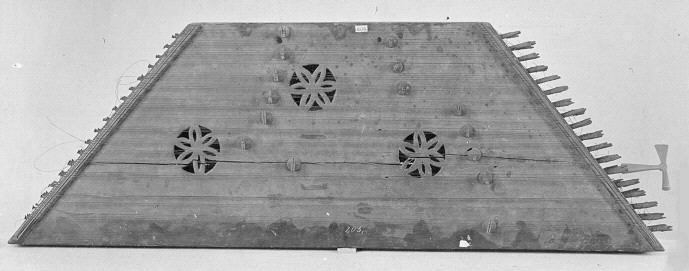 Courtesy of The Metropolitan Museum of Art, Public Domain
Construction
Established The Persian santur is a shallow trapezoidal box, typically 90–100 cm wide at the base, with 72 strings arranged in courses of four. The strings run horizontally across the soundboard, passing over two rows of moveable bridges that divide them into distinct sounding lengths. Each course of four strings is tuned in unison, and striking a course produces a full, ringing tone.
Attested The two rows of bridges — left and right — are critical to the instrument's design. Strings pass over both rows, and each side of a bridge produces a different pitch. This means each physical string can produce two different notes depending on which side of the bridge is struck. The bridge system effectively doubles the instrument's pitch range without doubling the number of strings.
Established The mezrab (mallets) are lightweight sticks, traditionally made of walnut or rosewood, with a slight flex. The player holds one in each hand, striking the strings with controlled wrist movements. The lightness of the mallets and the precision of the strike produce the santur's characteristic bright, bell-like attack.
Tuning and range
Attested The Persian santur is typically tuned to accommodate the dastgah being performed. Unlike the tar or setar, which can produce any pitch within their fretted range, the santur's fixed bridge positions mean that its available pitches are determined by tuning. Players retune between dastgah performances, adjusting the moveable bridges and string tensions to place the required pitches — including koron and sori inflections — at the correct positions.
Practice This retuning requirement makes the santur less flexible than fretted instruments for modulation during performance. A santur player cannot spontaneously introduce a pitch that falls outside the current tuning without stopping to adjust. This constraint shapes the instrument's role in ensemble performance: the santur establishes a stable pitch reference while more flexible instruments (tar, kamanche) handle ornamental inflection and modulation.
Playing technique
Established Santur technique centers on wrist control. Both hands strike alternately, producing rapid, even passages through alternating left-right strokes. The player can control dynamics through strike intensity and sustain through damping — touching a string lightly with a finger or mallet to stop its vibration.
Practice Key technique elements include:
- Alternating strokes: the fundamental pattern, enabling speed and evenness
- Tremolo (riz): rapid repeated strikes on a single course, sustaining a pitch beyond its natural decay
- Damping: controlling sustain to prevent pitch overlap in fast passages
- Dynamic shading: varying strike intensity for expressive phrasing
The santur in Persian dastgah
Attested The santur holds a prominent position in Persian classical music. Its bright, clear tone makes it effective both as a solo instrument and as part of the traditional ensemble alongside tar, kamanche, and tombak (goblet drum). During documents the santur's role in the classical ensemble as providing both melodic content and a sustaining harmonic backdrop through its ringing overtones.
Attested Notable santur masters include Faramarz Payvar (1932–2009), whose recordings and compositions helped define the modern Persian santur tradition, and Pashang Kamkar, who extended the instrument's repertoire and technique.
Turkish and Iraqi variants
Attested The santur also exists in Turkish and Iraqi musical traditions, though it occupies a less central position than in Persian music. The Turkish santur appears in historical sources as part of the Ottoman court ensemble but became less common than the qanun, which serves a similar registral and textural role with greater pitch flexibility through its mandal lever system.
Practice In Iraqi music, the santur (santir) remained more prominent and is closely associated with the performance of Iraqi maqam, particularly the vocal maqam tradition of Baghdad.
Where to go from here
The stringed instruments it plays alongside: Setar and Tar. The Turkish zither alternative: Qanun. The modal system it serves: The Dastgah System. Tuning the instrument: Practical Tuning Methods.
Sources
- Jean During, The Art of Persian Music (Mage Publishers, 1991)Textbook / peer-reviewed
- Hormoz Farhat, The Dastgah Concept in Persian Music (Cambridge University Press, 1990)Textbook / peer-reviewed
- Wikipedia contributors, 'Santur'Secondary sourceView sourceRetrieved 2026-07-30
External Resources
Between Frets is not affiliated with or sponsored by any of the resources listed below. Links are provided for educational purposes only.
- Faramarz Payvar — Santur & TombakEstablished
Album by the most influential Persian santur player and composer (1933-2009), who revolutionized santur technique and transformed it from a marginal instrument to a major solo voice in Persian classical music.
Essential listening — Payvar's recordings are the foundation of modern santur technique and the standard against which all subsequent santur performance is measured.
Performance titled 'Classical music from Iran — Great masters of the santur,' featuring performances in multiple dastgahs including Shur, Bayat-e Tork, Esfahan, and Homayun.
Watch a master navigate different dastgah systems within a single performance — demonstrates how the santur's tuning adapts to each modal framework.
Comprehensive guide covering the history, construction, and playing technique of the Persian santur, from ancient stone reliefs to modern concert halls.
Accessible English-language introduction to santur organology and history for readers wanting a broader overview alongside this article.
- Faramarz PayvarAttested
Archival SoundCloud profile for the foremost Persian santur player of the 20th century, whose performance school emphasized arpeggiated figures.
Access santur recordings that may include rare archival material not available on commercial streaming platforms.
- Amir ElSaffar (@amirelsaffar_official)Established
American musician who studied Iraqi maqam in Baghdad and performs as vocalist and santur player with Safaafir, the only ensemble in the US performing Iraqi maqam in its traditional format.
Follow the leading figure for understanding the Iraqi santur tradition — a distinct instrument and practice from the Persian santur covered in this article.
Practical guide to tuning the Persian santur, covering the relationship between tuning choices and dastgah selection.
The fact that the santur must be retuned for different dastgahs — unlike the qanun's mandal system — is a crucial practical consideration for students.
Related Articles
- InstrumentsThe Setar: Construction, Tuning, and the Persian Classical TraditionThe Persian long-necked lute of the dastgah tradition — its three-to-four-string history, mulberry-wood construction, four standard tunings, and quiet, fingernail-plucked technique.
- InstrumentsThe Tar: Construction, History, and the Persian Classical TraditionThe Persian long-necked lute — its figure-8 double-bowl body, lambskin soundboard, six strings in three courses, moveable gut frets, and central role in the dastgah tradition alongside the setar.
- InstrumentsThe Qanun: A Mechanical Solution to MicrotonalityA guide to the qanun — the large trapezoidal zither whose mandal lever system provides a physical mechanism for microtonal pitch adjustment, anchoring ensemble music across Turkish and Arabic traditions.