The Kamanche: Persian Spiked Fiddle
The kamanche (also kamancheh) is a bowed spike fiddle — its neck passes entirely through the body and emerges as a spike on which the instrument rests while playing. This construction, shared with related instruments across Central and West Asia, gives the kamanche its characteristic posture: held vertically, resting on the player's knee via the spike, and rotated to meet the bow rather than the other way around.
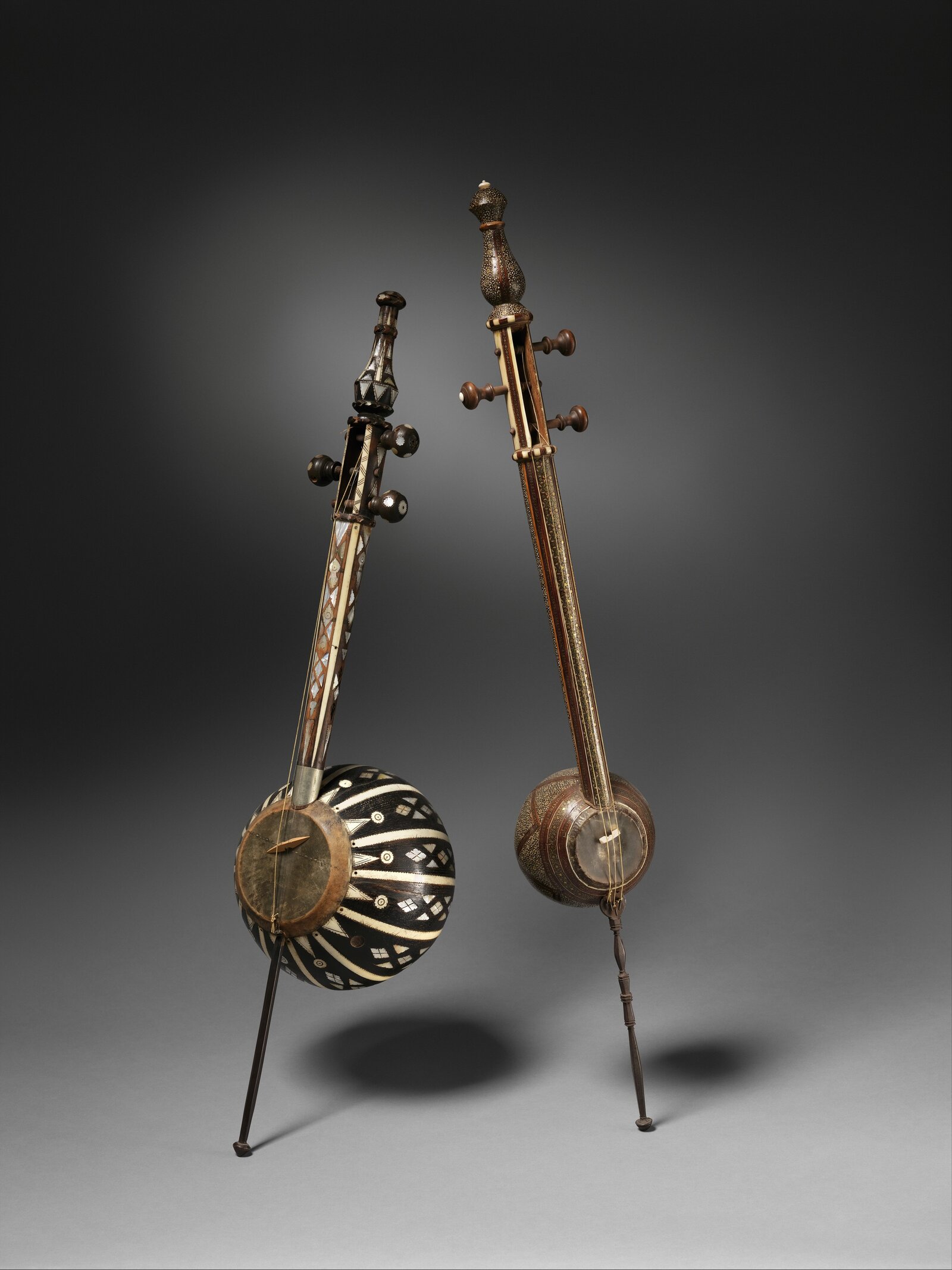 Courtesy of The Metropolitan Museum of Art, Public Domain
Construction
Established The kamanche has a small spherical or hemispherical body, traditionally carved from a single piece of wood (walnut is common) and covered with a thin animal-skin membrane that serves as the soundboard. The long neck has no frets — the player stops the strings by pressing fingertips directly against the neck, as with a violin.
Established Modern kamanche have four strings, tuned in fifths or fourths depending on the tradition. Earlier versions used three strings; the four-string configuration became standard during the 20th century. The strings are metal, and the bow is a simple arched stick with horsehair.
Attested The skin membrane gives the kamanche a warm, slightly buzzy timbre that contrasts with the clear ring of the tar and the bright attack of the santur. This timbral variety is one reason the three instruments complement each other in the Persian classical ensemble.
Playing technique
Established The player holds the kamanche vertically on the knee and rotates the instrument to bring different strings to the bow, rather than moving the bow across strings as a violinist does. This rotation technique is shared with other spike fiddles across the region.
Practice Key technique elements:
- Left-hand stopping: fingertip pressure directly on the unfretted neck, requiring accurate intonation by ear — there are no fret markers to guide pitch
- Instrument rotation: the body rotates to engage different strings, a distinctive motor skill that takes time to develop
- Bow control: lighter bow pressure than violin technique, producing the instrument's characteristic transparent tone
- Ornamental slides: the fretless neck allows continuous pitch sliding (portamento) between notes, which is central to the dastgah idiom
Role in Persian classical music
Attested The kamanche is one of the three core melodic instruments of the Persian classical ensemble, alongside the tar and santur. Its bowed sustain provides a sonic contrast to the plucked tar and struck santur, and its fretless neck gives it the pitch flexibility needed for the nuanced intonation of dastgah performance — including the subtle shifts of moteghayyer pitches.
Attested The kamanche tradition produced important master musicians whose recordings are essential listening for students of Persian music. Ali Asghar Bahari (1905–1995) is widely considered one of the greatest kamanche players, and his recordings with the radif established benchmark interpretations. Kayhan Kalhor (b. 1963) has brought the kamanche to international audiences through collaborations across musical traditions.
Practice The kamanche's fretless construction makes it the most flexible of the Persian melodic instruments for microtonal inflection. Where the tar and setar have frets that suggest specific pitch positions, the kamanche player must find every pitch by ear, making the instrument both demanding and expressive.
Related instruments
Attested The kamanche belongs to a family of spike fiddles found across a wide geographic area:
- Azerbaijani kamanche: closely related, used in mugham performance
- Turkish kemençe: shares the vertical playing position but has a different body shape and nail-stopping technique
- Rebab: an older bowed instrument associated with Sufi music and the medieval court tradition
- Ghijak: Central Asian variant found in Uzbek and Tajik traditions
Uncertain The exact historical relationships between these instruments are debated. They may represent independent developments from a common ancestor, or they may be branches of a single instrument tradition that diversified as it spread across the region.
Where to go from here
Its plucked counterpart: Tar. The intimate alternative: Setar. The struck instrument it plays alongside: Santur. The Turkish bowed equivalent: Kemençe. The modal system it serves: The Dastgah System.
Sources
- Jean During, The Art of Persian Music (Mage Publishers, 1991)Textbook / peer-reviewed
- Hormoz Farhat, The Dastgah Concept in Persian Music (Cambridge University Press, 1990)Textbook / peer-reviewed
- Wikipedia contributors, 'Kamancheh'Secondary sourceView sourceRetrieved 2026-07-30
External Resources
Between Frets is not affiliated with or sponsored by any of the resources listed below. Links are provided for educational purposes only.
- Kayhan Kalhor — Introduction to KamanchehEstablished
Kayhan Kalhor introduces the kamancheh, its history, construction, and playing technique. Kalhor is a three-time Grammy nominee and Grammy winner with the Silk Road Ensemble.
The most authoritative English-language introduction to the kamancheh, from the foremost living master of the instrument.
- Kayhan KalhorEstablished
Grammy-winning kamanche and setar player. Albums include 'Silent City' (with Brooklyn Rider), 'I Will Not Stand Alone,' 'Faryad,' and collaborations with Silk Road Ensemble.
Essential listening to develop ear for the kamanche's tonal character, from solo works to cross-cultural collaborations with Yo-Yo Ma.
Archival footage of Ostad Ali Asghar Bahari (1905-1995) performing kamanche in Segah at the Shiraz Arts Festival, circa 1972.
Historical footage of a legendary figure whose composed repertoire and traditional technique remain the benchmark for kamanche performance.
- Saeed FarajpouriEstablished
YouTube channel of one of the greatest living kamanche performers, who studied with Hassan Kamkar and collaborated with Mohammad Reza Shajarian for over three decades.
Watch performances from a master who represents the Kurdish-Iranian kamanche tradition and the Dastan Ensemble school.
- Kayhan KalhorAttested
Profile for the globally recognized kamanche virtuoso known for cross-cultural collaborations with Yo-Yo Ma's Silk Road Ensemble and Ghazal with Shujaat Khan.
Access kamanche recordings that may include live concert material and rare tracks not available on commercial streaming platforms.
Online private kamancheh lessons at all levels covering bow hold, finger placement, reading music, rhythm, and playing technique.
Find structured kamancheh instruction with a progressive curriculum from beginner through advanced levels.
Related Articles
- InstrumentsThe Tar: Construction, History, and the Persian Classical TraditionThe Persian long-necked lute — its figure-8 double-bowl body, lambskin soundboard, six strings in three courses, moveable gut frets, and central role in the dastgah tradition alongside the setar.
- InstrumentsThe Setar: Construction, Tuning, and the Persian Classical TraditionThe Persian long-necked lute of the dastgah tradition — its three-to-four-string history, mulberry-wood construction, four standard tunings, and quiet, fingernail-plucked technique.
- InstrumentsThe Santur: Hammered Dulcimer of Persian and Turkish MusicConstruction, tuning, and technique of the trapezoidal hammered dulcimer — its central role in Persian classical music, its presence in Turkish and Iraqi traditions, and how striking rather than plucking shapes its approach to makam and dastgah.