Music of the Sufi Lodges: Mevlevi and Bektashi Traditions
Ottoman classical music and Sufi devotional practice were never separate worlds. The tekke (lodge) and the saray (palace) shared performers, composers, and repertoire. Two Sufi orders in particular shaped the musical tradition: the Mevlevi, whose elaborate sema ceremony produced some of the most sophisticated compositions in the Ottoman canon, and the Bektashi, whose hymn tradition connected mystical poetry to folk musical practice.
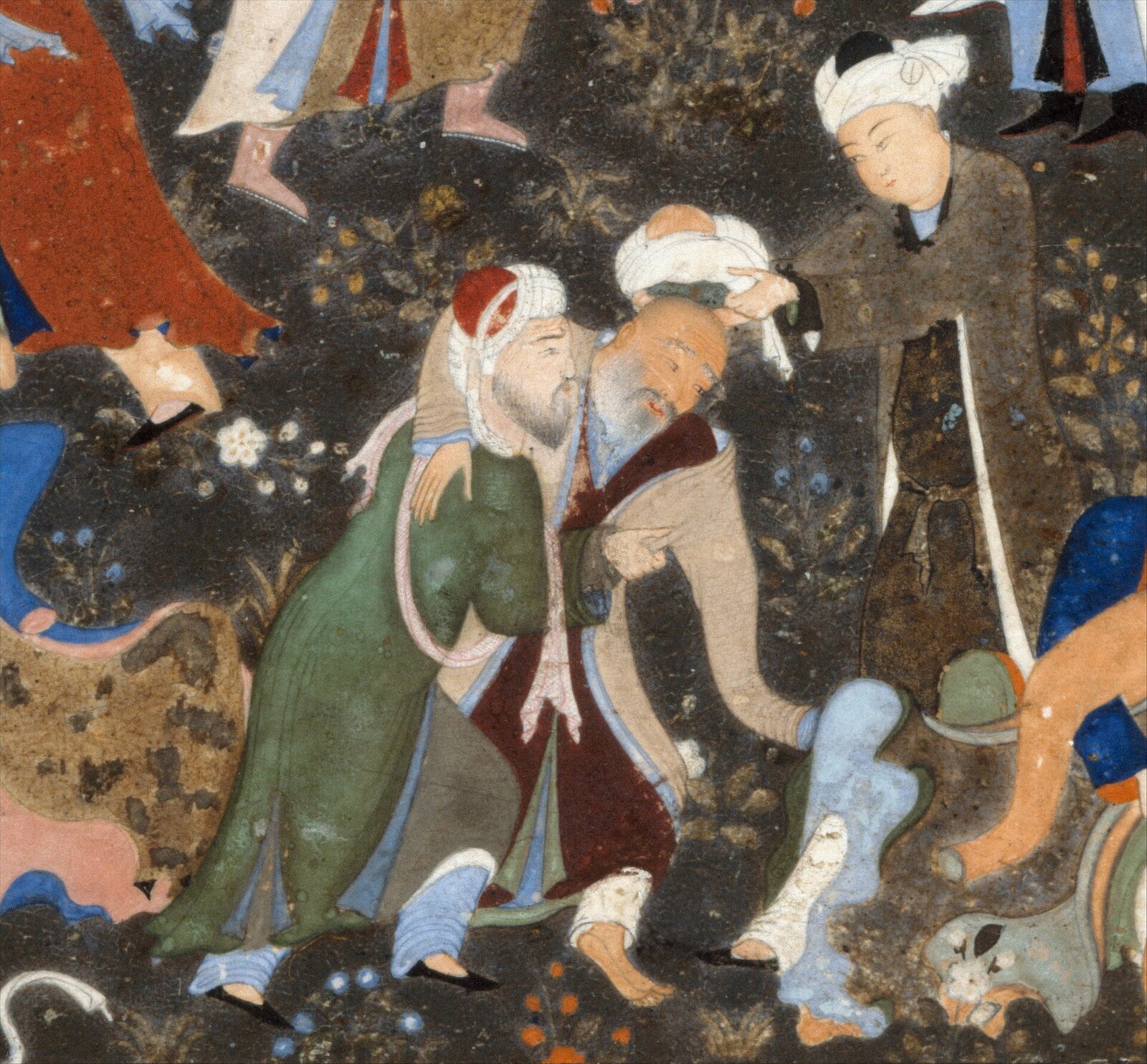 Courtesy of The Metropolitan Museum of Art, Public Domain
The Mevlevi order and the sema
Established The Mevlevi order was founded in Konya in the 13th century by the followers of Jalal al-Din Rumi (1207–1273). The order's defining ritual is the sema — the whirling ceremony in which dervishes rotate as a form of active meditation, seeking spiritual union through controlled physical movement accompanied by music.
Established The sema is not a concert. It is a structured liturgical event with a prescribed musical sequence:
- Na't-i Şerif — a vocal eulogy to the Prophet Muhammad, traditionally the setting by Buhurizade Mustafa Itri (c. 1640–1712) in Makam Rast, performed unaccompanied
- Ney taksimi — an improvised ney solo establishing the makam of the ceremony
- Peşrev — an instrumental composition in large usul, during which the dervishes process
- Four Selam — four sections of increasing tempo, each in a different usul, during which the whirling takes place
- Son Peşrev and Son Yürük Semai — closing instrumental pieces
- Concluding prayer
Attested Feldman documents the Mevlevi ayin — the composed vocal-instrumental form that accompanies the four selam — as one of the most architecturally complex forms in Ottoman music. Each ayin is composed in a specific makam, and the greatest Ottoman composers contributed to the repertoire. The surviving ayin corpus preserves compositions spanning several centuries.
The ney as sacred instrument
Established The ney holds a unique position in the Mevlevi tradition: it is the only instrument associated with Rumi himself, who opened his masterwork the Masnavi with the famous lines about the reed flute's lament for separation from the reed bed — a metaphor for the soul's longing for divine reunion.
Attested This literary and spiritual association elevated the ney above other instruments in the Mevlevi context. While the sema ensemble includes kudüm (small kettledrums), rebab, and other instruments, the ney's voice carries a specific theological weight. Many of the most celebrated Ottoman neyzen were Mevlevi initiates, and ney pedagogy was historically inseparable from Mevlevi training.
Practice The connection between ney playing and Mevlevi discipline shaped how the instrument was taught: breath control, sustained tones, and ornamental subtlety were framed not just as musical techniques but as spiritual practices. This pedagogical tradition continues to influence ney instruction even in secular conservatory settings.
Mevlevi composers in the classical canon
Attested The overlap between Mevlevi membership and Ottoman court composition was extensive. Among the most significant Mevlevi-affiliated composers:
- Itri (c. 1640–1712): his Na't-i Şerif in Rast remains the standard opening of the sema ceremony
- Dede Efendi (1778–1846): composed in both court and tekke contexts; his Rast and Hüzzam ayinler are central to the Mevlevi repertoire
- Zekai Dede (1825–1897): student of Dede Efendi, preserved and transmitted large portions of the classical repertoire
Practice The Mevlevi tekke functioned as a conservatory before formal conservatories existed. Young musicians entered as novices and received years of training — in music, poetry, calligraphy, and etiquette — before advancing within the order. This made the tekke one of the primary institutions through which the meşk tradition operated.
The Bektashi tradition
Attested The Bektashi order, associated with Hacı Bektaş Veli (13th century), took a different musical path. Where the Mevlevi tradition cultivated the classical court idiom, the Bektashi tradition was rooted in Anatolian folk practice — Turkish-language poetry, syllabic melodies, and the bağlama/saz rather than the ney and tanbur.
Attested The primary musical form of the Bektashi tradition is the nefes — a mystical hymn sung to bağlama accompaniment. Nefes texts draw on the poetry of Yunus Emre, Pir Sultan Abdal, and other Anatolian mystic poets, addressing themes of divine love, social justice, and the unity of existence.
Practice The Bektashi musical tradition is less thoroughly documented in Ottoman music scholarship than the Mevlevi tradition. This reflects a genuine historical asymmetry: the Mevlevi order was closely allied with the Ottoman court and its music circulated in elite circles, while the Bektashi tradition was more closely connected to Janissary culture and rural Anatolian communities, leaving fewer written records.
The Alevi-Bektashi connection
Attested The Bektashi tradition overlaps extensively with Alevi musical practice. The cem ceremony — the central Alevi ritual — incorporates semah (a form of sacred dance distinct from the Mevlevi sema), nefes hymns, and bağlama performance. Whether Alevi and Bektashi traditions are branches of a single tradition or distinct phenomena with shared elements is a matter of ongoing scholarly and community debate.
Practice For students of Turkish music, the Alevi-Bektashi repertoire represents a musical world that operates by different rules from the court tradition: simpler modal structures, syllabic text setting, a preference for the bağlama's timbre over the tanbur's, and a different relationship between melody and poetry.
1925 and after
Established In 1925, the Turkish Republic closed all Sufi lodges and banned the orders' ritual activities as part of Atatürk's secularization reforms. The Mevlevi tekke ceased to function as a living musical institution. The sema was eventually permitted again — first as a cultural performance (from the 1950s in Konya), and later under UNESCO recognition (Mevlevi sema ceremony inscribed on the Representative List in 2008).
Attested The closure disrupted but did not destroy the musical transmission. Mevlevi-trained musicians like Sadettin Heper (1899–1980) worked to preserve the ayin repertoire within the secular conservatory system. Today, the Mevlevi musical heritage survives in concert performance, recordings, and conservatory teaching — detached from its original ritual context but musically intact.
Practice The Bektashi and Alevi traditions, being less dependent on centralized lodges, were affected differently. Their music continued in private gatherings and rural communities, and experienced a revival in the late 20th century through folk music research and recording projects.
Where to go from here
The ney's construction and technique: Ney. The court tradition: Ottoman Court Music. Composed forms used in the sema: Classical Forms. Key composers mentioned here: Key Figures in Makam Theory. What happened after the lodges closed: Modern Developments.
Sources
- Walter Feldman, Music of the Ottoman Court (Intercultural Music Studies 10, VWB, 1996)Textbook / peer-reviewed
- Karl Signell, Makam: Modal Practice in Turkish Art Music (Asian Music Publications, 1977)Textbook / peer-reviewed
- Wikipedia contributors, 'Mevlevi Order'Secondary sourceView sourceRetrieved 2026-07-30
- Wikipedia contributors, 'Sema (Mevlevi)'Secondary sourceView sourceRetrieved 2026-07-30
External Resources
Between Frets is not affiliated with or sponsored by any of the resources listed below. Links are provided for educational purposes only.
- UNESCO: Mevlevi Sema CeremonyEstablished
UNESCO designation of the Mevlevi Sema Ceremony as a Masterpiece of Oral and Intangible Heritage of Humanity (2005), documenting the ceremony's four-part musical structure.
Authoritative international recognition of the tradition this article describes, with documentation of the sema's precise musical structure.
Article on the history and spiritual significance of the whirling dervish dance, tracing its origins to Rumi and the Mevlevi Order founded in 1273.
Covers the historical origins of the sema ceremony and its spiritual framework discussed in this article.
Comprehensive Turkish music resource with sections for Mevlevi ceremonial music notation, sacred vocal pieces, and ney instruction.
Contains the notated Mevlevi ayin repertoire and sacred music discussed in this article, emphasizing the ney's spiritual role as 'a mediator that contacts you with divinity.'
- NPR: Whirling Dervishes and RumiEstablished
NPR feature on the whirling dervish tradition and its connection to Rumi.
Accessible journalistic introduction to the Mevlevi tradition for general audiences approaching this article's subject.
Academic article examining contemporary Mevlevi music practices, published by the Orient-Institut Istanbul.
Covers how the Mevlevi musical tradition has evolved after the 1925 tekke closures discussed at the end of this article.
Video recording of a performance by the Istanbul Meshk Ensemble at Harvard, directed by A. Eylul Yalcinkaya, Ph.D.
High-quality performance of Ottoman classical repertoire in an academic context -- demonstrates the living mesk tradition that sustained Mevlevi music.
- DivanMakam -- Ottoman MusicAttested
Community forum article on Ottoman music covering mesk, Mevlevi ayins as educational tools, and institutional history.
Covers how Mevlevi lodges served as primary channels for mesk-based education -- the institutional overlap between Sufi practice and music transmission.
Related Articles
- HistoryOttoman Court Music: A Living TraditionThe rise, flourishing, and near-destruction of Ottoman classical music — from the Enderun palace school and the meşk tradition to the Mehter military band, the great composers, and the Republic-era suppression that nearly silenced it all.
- InstrumentsThe Ney: Construction, Technique, and TraditionA guide to the ney — the end-blown reed flute central to Turkish makam and Persian dastgah traditions, its demanding embouchure, and its place in Ottoman and Mevlevi musical practice.
- Turkish MakamTurkish Classical Forms: Peşrev, Saz Semaisi, Beste, and ŞarkıThe named composition forms of Ottoman/Turkish classical music — their structure, usul associations, and place within the fasıl suite — from the instrumental peşrev to the strophic şarkı that dominates the modern repertoire.