Central Asian Connections: Shashmaqam and the Silk Road
Turkish makam, Persian dastgah, Arabic maqam — these are the modal traditions this site focuses on. But they are not the only branches of a much larger family. Across Central Asia, from Azerbaijan to Xinjiang, related traditions preserve the same root concept — named modal frameworks governing melody — under cognate names: mugham, shashmaqam, muqam. Understanding these connections illuminates where the traditions come from and why their vocabularies overlap.
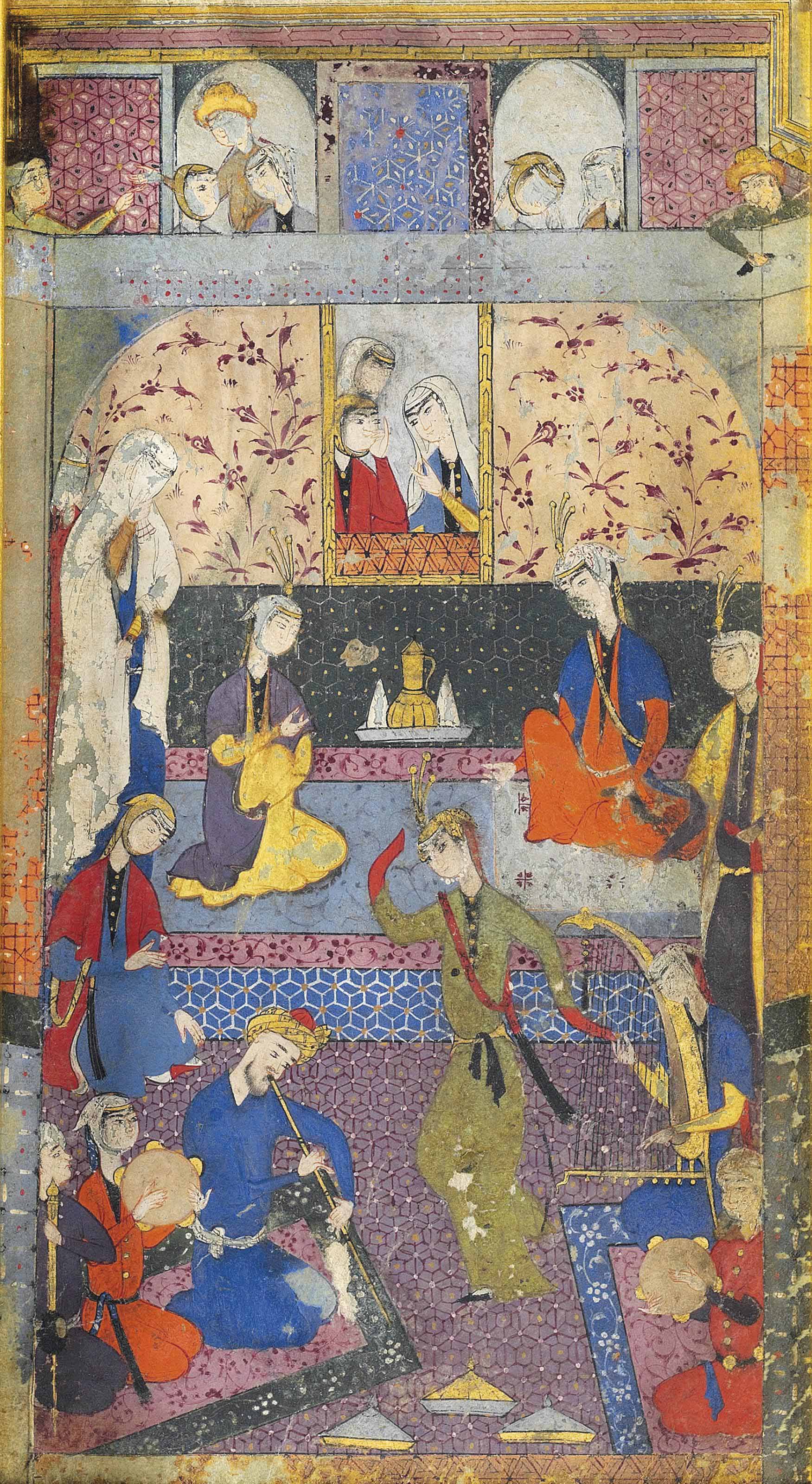 Safavid court musicians, circa 1600
A shared root
Established The Arabic word maqam (place, station) is the common ancestor of the Turkish makam, Azerbaijani mugham, Uzbek/Tajik maqom, and Uyghur muqam. These are not borrowed words that happen to sound similar — they are the same word, transmitted along trade and scholarly routes, adapted to local languages, and applied to local musical practices that share structural DNA while diverging in detail.
Attested The theoretical lineage runs through specific historical figures: Safiyüddin al-Urmawi (13th century, Baghdad) and Abdülkadir Maraghi (15th century, Herat and Samarkand) produced treatises that were read and cited across the entire region, from Ottoman Istanbul to Timurid Central Asia. Their classifications and terminology became the shared intellectual inheritance of court music traditions across the Islamic world.
Shashmaqam: six maqams of Bukhara
Established The Shashmaqam ("six maqams") is the classical music tradition of Uzbekistan and Tajikistan, centered historically in Bukhara and Samarkand. Its six named maqams — Buzruk, Rost, Navo, Dugoh, Segoh, and Iroq — immediately reveal their kinship with Turkish and Persian terminology:
| Shashmaqam | Turkish equivalent | Persian equivalent |
|---|---|---|
| Rost | Rast | Rast-Panjgah |
| Dugoh | Dügâh (perde) | Dogah |
| Segoh | Segâh | Segah |
| Navo | Neva (perde) | Nava |
| Iroq | Irak (makam) | — |
| Buzruk | Büzürk (historical) | Bozorg |
Attested Each maqam in the Shashmaqam is not simply a scale but a large-scale suite — an ordered sequence of instrumental and vocal pieces, analogous in concept (though not in detail) to the Ottoman fasıl or the Persian dastgah's progression through gusheh. Theodore Levin's The Hundred Thousand Fools of God documents the tradition's living practice in Bukhara and its relationship to Persian literary culture.
Attested The Shashmaqam was inscribed on UNESCO's Representative List of the Intangible Cultural Heritage of Humanity in 2003, as a joint Tajikistan-Uzbekistan nomination. This was among the first musical traditions recognized under the program.
Azerbaijani mugham
Established Mugham is the classical modal tradition of Azerbaijan, closely related to both Turkish makam and Persian dastgah. Azerbaijani mugham was inscribed on UNESCO's list in 2003 (as a Masterpiece of Oral and Intangible Heritage) and again in 2008 on the Representative List.
Attested Mugham occupies a middle position between the Turkish and Persian systems. Like dastgah, it is organized around large modal complexes with characteristic melodic progressions. Like makam, it has historical connections to Ottoman court practice through centuries of cultural exchange in the Caucasus. The mugham tradition maintains a living improvisatory practice — mugham performance is semi-improvised within the framework of named modal structures, closer in spirit to Persian dastgah performance than to the composed orientation of Turkish fasıl.
Uyghur Twelve Muqam
Attested The Twelve Muqam of the Uyghur people of Xinjiang (western China) represents the easternmost major branch of the maqam family. Rachel Harris's The Making of a Musical Canon in Chinese Central Asia documents how this tradition was codified in the mid-20th century from oral performance into a fixed sequence of twelve large suites.
Attested The Uyghur Twelve Muqam was inscribed on UNESCO's Representative List in 2005 (originally as a Masterpiece, transferred in 2008). Harris's work examines how the canonization process — selecting, ordering, and notating a diverse oral tradition — inevitably transformed what it sought to preserve.
Uncertain The exact historical relationship between the Uyghur muqam and the Central Asian shashmaqam is debated. Shared terminology and structural similarities suggest common ancestry, but the geographical and political separation of the traditions makes direct transmission difficult to trace with certainty.
What connects them
Attested Across all these traditions, certain structural features recur:
- Named modal frameworks that are more than scales — they include characteristic melodic behavior, emotional associations, and prescribed performance contexts
- Hierarchical pitch relationships — not all notes in a mode are equal; some serve as resting points, others as points of emphasis or tension
- Large-scale formal organization — modes are performed not as isolated scales but as components of extended suites or improvised sequences
- Oral transmission as the primary pedagogical method, with notation arriving late and never fully replacing ear-based learning
- Poetry as the vehicle for vocal music — the relationship between text and melody is central in every branch
Practice These shared features are not coincidental. They reflect the common theoretical inheritance from the medieval Islamic scholarly tradition — from Safiyüddin through Maraghi to the regional schools that developed in Istanbul, Isfahan, Bukhara, Baku, and Kashgar.
What divides them
Attested Despite shared ancestry, the traditions have diverged significantly:
- Tuning: Turkish theory commits to a 53-comma grid; Persian theory rejects fixed temperaments; Central Asian traditions use various tuning approaches adapted to local instruments
- Notation: Turkish music adopted modified Western staff notation; Persian music uses koron/sori adaptations; Shashmaqam and mugham were largely unnotated until the 20th century
- Institutional context: nation-state formation in the 19th–20th centuries separated traditions that had been in dialogue for centuries. Soviet cultural policies shaped Uzbek, Tajik, and Azerbaijani musical institutions in ways that had no parallel in Turkey or Iran
- Repertoire: while modal names overlap, the actual compositions, melodic formulas, and performance practices are distinct
Uncertain How much of the apparent similarity reflects genuine shared ancestry versus independent parallel evolution from similar musical materials is an open question. The terminology is clearly inherited, but the degree to which underlying musical practice was shared — as opposed to just the theoretical vocabulary — is harder to establish.
Where to go from here
The shared theoretical ancestor: Safiyüddin Urmevi. The court tradition that transmitted it westward: Ottoman Court Music. The Persian branch: The Dastgah System. Comparing modal systems across cultures: Comparative Modal Theory. Turkish and Persian systems compared: Makam and Dastgah.
Sources
- Theodore Levin, The Hundred Thousand Fools of God: Musical Travels in Central Asia (Indiana University Press, 1996)Textbook / peer-reviewed
- Rachel Harris, The Making of a Musical Canon in Chinese Central Asia: The Uyghur Twelve Muqam (Ashgate, 2008)Textbook / peer-reviewed
- Walter Feldman, Music of the Ottoman Court (Intercultural Music Studies 10, VWB, 1996)Textbook / peer-reviewed
- UNESCO, 'Shashmaqom music' (Intangible Cultural Heritage)Practitioner-verifiedView sourceRetrieved 2026-07-30
External Resources
Between Frets is not affiliated with or sponsored by any of the resources listed below. Links are provided for educational purposes only.
Podcast episode from the Smithsonian's National Museum of Asian Art dedicated to the Shashmaqam tradition, part of a broader Music of Central Asia series.
Smithsonian-backed audio documentation of the Shashmaqam tradition central to this article's survey of Central Asian modal music.
- UNESCO: Azerbaijani MughamEstablished
UNESCO Intangible Cultural Heritage listing for Azerbaijani Mugham, documenting its improvisational nature, instrumentation, and oral transmission.
Official international recognition of the Azerbaijani mugham tradition discussed as a key branch of the maqam family in this article.
- UNESCO Silk Road: Uyghur Muqam of XinjiangEstablished
UNESCO Silk Road documentation of the Uyghur Muqam, covering its historical development along the Silk Road and four regional styles.
Documents the easternmost branch of the maqam tradition family discussed in this article, tracing the Silk Road transmission route.
Article covering the Shashmaqam's relationship between music and poetry, its development in Samarkand and Bukhara, and the Sufi poetry connection.
Provides the cultural and poetic context for the Shashmaqam tradition -- the etymology (shash = six, maqam = mode) and its Sufi dimensions.
- Alim Qasimov: Talk to Al JazeeraEstablished
Al Jazeera interview with legendary Azerbaijani mugham singer Alim Qasimov at Baku's International Mugham Center, discussing preservation and redefinition of the tradition.
Living voice of the mugham tradition discussed in this article, with performance excerpts demonstrating the connection between Central Asian and Middle Eastern modal practices.
Related Articles
- HistoryOttoman Court Music: A Living TraditionThe rise, flourishing, and near-destruction of Ottoman classical music — from the Enderun palace school and the meşk tradition to the Mehter military band, the great composers, and the Republic-era suppression that nearly silenced it all.
- HistorySafiyüddin al-Urmawi: The Foundation of Ottoman-Persian Music TheoryHow a 13th-century theorist at the Abbasid court produced two treatises that shaped makam and dastgah theory for seven centuries — his 17-tone scale, systematic interval classification, and enduring influence on Arel, Maraghi, and modern conservatory pedagogy.
- Persian DastgahThe Dastgah System: An Introduction to Persian Classical MusicAn overview of the twelve-mode dastgah system — seven primary dastgahs, five satellite avazes, and the radif tradition that defines Persian classical music.