Safiyüddin al-Urmawi: The Foundation of Ottoman-Persian Music Theory
Every branch of the Middle Eastern and Central Asian modal music tradition — Turkish makam, Persian dastgah, Arabic maqam, Central Asian shashmaqam — traces its theoretical lineage through one figure: Safiyüddin al-Urmawi (also transliterated Urmevi in Turkish sources), a 13th-century musician, theorist, and court servant who produced two treatises that defined how these traditions understood their own intervals for centuries to come.
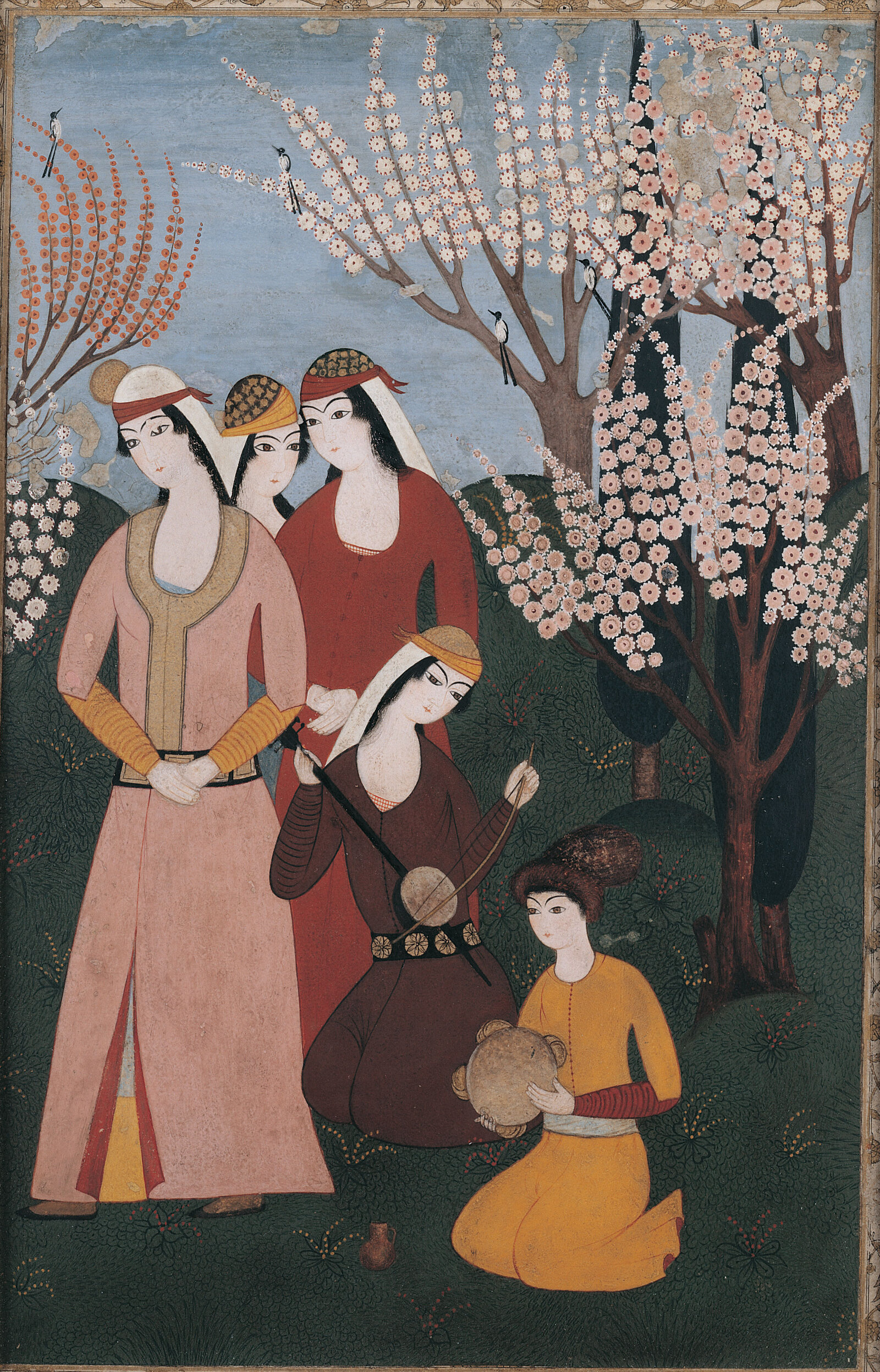 18th-century Ottoman musical gathering
Life at the Abbasid court
Established Safiyüddin (c. 1216–1294) was born in Urmia (modern-day northwestern Iran) and served at the Abbasid court in Baghdad as a musician and librarian. He lived through the Mongol sack of Baghdad in 1258 — one of the most destructive events in Islamic cultural history — and reportedly survived by impressing the Mongol conqueror Hulagu Khan with his musical skill. He continued working under the Ilkhanid rulers who succeeded the Abbasids.
Attested His position at the Abbasid court gave him access to both the Greek-influenced intellectual tradition (through Arabic translations of Ptolemy and Aristoxenus) and the living practice of court musicians. This dual grounding — theoretical and practical — distinguishes his work from purely speculative treatises.
The two treatises
Established Safiyüddin produced two major works:
Kitab al-Adwar ("Book of Cycles") is the more widely known. It presents a systematic classification of melodic modes and rhythmic cycles, establishing terminology and organizational frameworks that subsequent theorists — including Abdülkadir Maraghi in the 15th century — would adopt and extend.
Risala al-Sharafiyya ("Treatise dedicated to Sharaf") is the more technically detailed. Written for his patron, it develops the mathematical basis of his interval theory with greater rigor, including a systematic derivation of intervals from stacked perfect fifths.
Attested Owen Wright's The Modal System of Arab and Persian Music, A.D. 1250–1300 provides the most thorough modern analysis of both treatises, reconstructing Safiyüddin's theoretical system in the context of his contemporaries and predecessors.
The 17-tone scale
Established Safiyüddin's most enduring theoretical contribution is a 17-tone scale derived from Pythagorean tuning — that is, from stacking acoustically pure perfect fifths (ratio 3:2). By generating tones through successive fifths and folding them back into a single octave, he produced a set of 17 distinct pitch positions that could accommodate the intervals used in the modal practice of his time.
Attested The 17-tone framework was not arbitrary. It captured the intervals that mattered in practice: whole tones of approximately 204 cents (Pythagorean major seconds), limmas of approximately 90 cents (the Pythagorean minor second), and the interval between them — the apotome of approximately 114 cents. These three interval sizes, combined within the 17-tone framework, generated the tetrachords and pentachords from which modes were built.
Uncertain The exact mapping between Safiyüddin's theoretical intervals and the pitches performers actually produced is debated. Wright cautions against reading the treatises as precise descriptions of performance practice, noting that theoretical systems of this period describe ideal frameworks, not necessarily what musicians did with their fingers.
From 17 to 53
Attested Safiyüddin's 17-tone Pythagorean framework is the direct ancestor of the 53-comma system that the Arel-Ezgi-Uzdilek theory adopted in the 20th century. The mathematical connection is straightforward: if you continue stacking perfect fifths beyond 17, you reach 53 fifths — the point at which the circle very nearly closes (the discrepancy is less than 4 cents). The Holdrian comma, the basic unit of AEU theory, is simply 1/53 of an octave.
Attested This means that modern Turkish conservatory theory is, in a real sense, an extension of Safiyüddin's original Pythagorean approach. The 17-tone scale and the 53-comma grid are not competing systems — they are different resolutions of the same tuning principle. Safiyüddin chose 17 because it was sufficient for the modes he catalogued. AEU chose 53 because it provides finer resolution for the expanded modal vocabulary of later centuries.
The Maraghi connection
Established Safiyüddin's most important intellectual successor was Abdülkadir Maraghi (c. 1360–1435), a musician and theorist who served at the Timurid court in Herat and Samarkand. Maraghi's treatises explicitly build on Safiyüddin's framework, extending the modal catalogue and refining the interval classifications.
Attested The Safiyüddin-Maraghi theoretical lineage forms the bridge between the Abbasid-era modal system and the Ottoman and Timurid traditions that emerged in the 15th century. Feldman traces this transmission in Music of the Ottoman Court, showing how Ottoman theorists inherited concepts and terminology that originated in Safiyüddin's Baghdad-era work and passed through Maraghi's Central Asian elaboration.
Legacy across traditions
Attested Safiyüddin's influence is not confined to one tradition. His theoretical framework — modified, extended, and sometimes contested — shaped how multiple cultures understood modal music:
- Ottoman/Turkish: the AEU system's Pythagorean foundation descends directly from his stacked-fifth approach
- Persian: while Persian theory followed a different evolutionary path (rejecting rigid interval grids in favor of Farhat's flexible approach), Safiyüddin's modal classifications inform how scholars discuss the historical development of dastgah
- Central Asian: the Shashmaqam's theoretical vocabulary carries terminology traceable to Safiyüddin's and Maraghi's classifications
- Arabic: the modern Arabic maqam system's theoretical literature frequently cites Safiyüddin as its foundational authority
Practice For students of any of these traditions, Safiyüddin matters not as a figure to memorize but as an explanation of why the theoretical vocabularies of Turkish, Persian, Arabic, and Central Asian modal music overlap so extensively despite their divergent evolution. The shared terminology is not coincidence — it reflects a shared theoretical inheritance.
Where to go from here
The mathematics he inspired: Holdrian Commas. The modern system built on his foundation: Arel-Ezgi-Uzdilek. Key figures who followed: Key Figures in Makam Theory. How Turkish and Persian paths diverged: Makam and Dastgah. The Central Asian branch: Central Asian Connections.
Sources
- Walter Feldman, Music of the Ottoman Court (Intercultural Music Studies 10, VWB, 1996)Textbook / peer-reviewed
- Owen Wright, The Modal System of Arab and Persian Music, A.D. 1250–1300 (Oxford University Press, 1978)Textbook / peer-reviewed
- Wikipedia contributors, 'Safi al-Din al-Urmawi'Secondary sourceView sourceRetrieved 2026-07-30
- Karl Signell, Makam: Modal Practice in Turkish Art Music (Asian Music Publications, 1977)Textbook / peer-reviewed
External Resources
Between Frets is not affiliated with or sponsored by any of the resources listed below. Links are provided for educational purposes only.
Official Turkish cultural resource documenting court music history from the Topkapi palace era, including the theoretical lineage from Urmevi through later Ottoman theorists.
Places Urmevi's theoretical contributions in the broader Ottoman musical tradition that built on his foundational work.
- SMT-V: Understanding Turkish Classical MakamEstablished
Peer-reviewed video article from the Society for Music Theory explaining the cesni framework central to Turkish makam -- a direct descendant of Urmevi's systematic interval classification.
Demonstrates how Urmevi's foundational interval theory evolved into the modern cesni-based makam analysis discussed at the end of this article.
- Brill: Music of the Ottoman CourtEstablished
Academic publication on Ottoman court music covering makam theory from its origins in the Urmevi-Maraghi theoretical tradition through the AEU codification.
Provides detailed scholarly analysis of the theoretical lineage from Urmevi through Maraghi to modern Turkish theory discussed in this article.
Related Articles
- Tuning SystemsHoldrian Commas and 53-TET: The Mathematics of Ottoman TuningHow the 53-tone equal temperament system and Holdrian commas became the theoretical language of Turkish makam intonation.
- HistoryThe Arel-Ezgi-Uzdilek System: Codifying Turkish Makam TheoryHow Rauf Yekta, Hüseyin Sadettin Arel, Suphi Ezgi, and Salih Murat Uzdilek gave Turkish makam music its standardized 24-tone theory, and why the system remains both dominant and contested.
- HistoryKey Figures in Turkish Makam TheoryThe scholars and musicians who shaped the theoretical framework of Turkish makam music — from Safiyüddin Urmevi's 13th-century systematic intervals to the contested modern frameworks of the 20th century.