The Cümbüş: Turkey's Metal-Bodied Oud
The cümbüş is a fretless, twelve-string Turkish instrument that replaces the oud's carved wooden bowl with a spun-aluminum resonator and a tensioned skin head — the same tuning family and left-hand technique as the oud, in a completely different body. Invented in Istanbul around 1930, it became one of the loudest, cheapest, and most socially contested instruments in modern Turkish music.
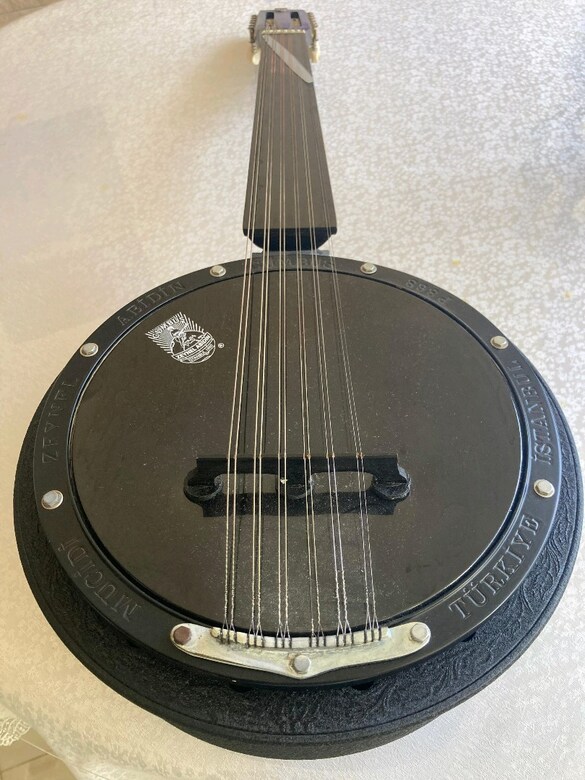
Invention: a cheaper, louder oud
Attested The cümbüş was apparently invented in Istanbul in 1930 by Zeynel Abidin (b. Skopje, 1881 – d. Istanbul, 1947), who later adopted "Cümbüş" as his own surname after the instrument's success. Eric Ederer, whose 2006 master's thesis remains the primary academic study of the instrument, is careful to hedge both the date and the attribution: the story survives mainly through the Cümbüş family's own oral history, corroborated only partially by outside documentation. Zeynel Abidin's family had run an arms-manufacturing business — swords, then artillery — relocated from Skopje to Izmir and finally to Istanbul after the Turkish War of Independence (1919–1923). That background made a spun-aluminum body a natural choice: the workshop already knew how to shape sheet metal, and skins of goat or calf hide were cheaper and faster to prepare than a carved wooden oud bowl.
Attested Per the family narrative Ederer documents from 2005 interviews with Zeynel Abidin's descendants, he demonstrated the new instrument to Mustafa Kemal Atatürk at a dinner party in January 1930, and Atatürk himself supplied the name — reportedly exclaiming "cümbüş" ("revelry," "fun") on hearing it played, after which the Presidential Music Committee certified it for state orchestras within days. This is best understood as the Cümbüş family's own foundational story rather than independently verified history, but it accurately reflects how the instrument was marketed from the start: modern, affordable, and patriotically Turkish. Zeynel Abidin received a patent for the design later that year.
Construction
Established The body is a bowl of spun aluminum — sheet metal shaped on a lathe — roughly 30 cm across, with a tensioned membrane head (originally goat or calf skin, largely replaced by Mylar since the 1960s) held taut by an adjustable metal rim. A wooden floating bridge rests on the skin and transmits string vibration into it, the same principle a banjo uses. The standard neck is fretless and built like an oud neck, strung in six courses; a bolted joint — rather than a glued neck-body union — is what makes the neck detachable.
One body, many necks
Established Interchangeable necks were part of the original design: alongside the standard oud-style neck, Zeynel Abidin's workshop offered saz, cura, mandolin, twelve-string guitar, and tanbur necks; an ud-style option was tried and discontinued early for lack of interest. Attested The bowed tanbur-neck version (cümbüş yaylı tanbur) was the one variant the conservative Turkish classical establishment accepted, entering state ensembles from the 1950s as a substitute for the bowed tanbur. Within a few years of the 1930 debut, other luthiers were already building close imitations and hybrids of the instrument — evidence that the design registered as a genuine innovation rather than a novelty.
Established Without a qualifier, "cümbüş" means this standard oud-neck version: fretless, six courses, each doubled in unison — twelve strings total, unlike a 12-string guitar's octave-paired doubling. A mistuned unison pair produces audible beating, and eliminating that beating is the tuning method.
Tuning and playing technique
Attested The standard cümbüş is conventionally tuned a fourth above the Turkish oud and played with the same mızrap (plectrum) technique — a player's right hand needs no adjustment. As with the oud, exact tunings vary by player and region, and the lowest course (the bam) is routinely retuned to the karar (tonic) of whatever piece is being played rather than left fixed; a fuller account of oud and cümbüş tuning families belongs to its own article. What matters here is that the cümbüş was built to slot directly into existing oud technique, not to require new technique of its own.
Uncertain Ederer, a player of both instruments himself, suggests that the cümbüş's shorter sustain on stopped notes compared to the oud's longer decay may be part of why cümbüş playing leans on continuous tremolo and heavier ornamentation. He presents this explicitly as his own informed speculation rather than a documented finding, and no other source consulted here confirms or disputes it.
Popular, but never prestigious
Attested The cümbüş found its first audience in the meyhanes (drinking-and-music taverns) of Istanbul and Izmir, and in outdoor wedding and festival contexts where volume and low cost mattered more than refinement. Ederer's central argument is that the cümbüş has functioned since 1930 as a marker of social and ethnic "Otherness" in Turkish public life — and that which "Other" it signals has shifted over time. In the early Republic it was documented among urban minority professional musicians (Greek, Armenian, and Jewish), among Romani (Roman) musicians, and in Kurdish folk contexts in southeastern Turkey; in recent decades the association has narrowed mostly onto working-class Romani wedding musicians, before broadening again into arabesk and Turkish pop. This is Ederer's own interpretive framework, not uncontested consensus — but it is grounded in his fieldwork and the period sources he cites, not speculation.
Attested The Turkish classical establishment rejected the cümbüş almost immediately. Critics called it "degenerated" and cheap-looking, too loud for ensemble playing, and — per the period sources Ederer cites — a competitive threat to oud luthiers. Composer Mesut Cemil Bey, who directed state radio's classical broadcasts, personally kept it out of broadcast ensembles even after the Presidential Music Committee's endorsement, and in 1965 Turkish state radio and television banned the standard cümbüş from broadcast outright — a move Ederer reads as an oblique attempt to suppress the arabesk genre it had become associated with. That rejection by the conservatory establishment, more than any quality of the instrument itself, is why a cümbüş-specific teaching tradition never developed.
Relationship to the oud
Established The cümbüş borrows the oud's tuning family, course structure, and left-hand fingering wholesale — a player who already knows the oud can pick up a standard cümbüş with no new technique to learn, only a new instrument to adjust to. That transfer runs in both directions: because the cümbüş never developed its own method literature, oud instruction is what nearly all cümbüş players actually study. See The Oud for that shared technical foundation.
Sources
- Eric Ederer, "The Cümbüş as Instrument of 'the Other' in Modern Turkey" (M.A. thesis, Ethnomusicology, University of California, Santa Barbara, 2006)Textbook / peer-reviewed
- Eric Ederer, "The Theory and Praxis of Makam in Classical Turkish Music, 1910–2010" (Ph.D. dissertation, University of California, Santa Barbara, 2011)Textbook / peer-reviewed
- Karl Signell, Makam: Modal Practice in Turkish Art Music (Asian Music Publications, 1977)Textbook / peer-reviewed
- Wikipedia contributors, "Cümbüş"Secondary sourceView sourceRetrieved 2026-07-29
External Resources
Between Frets is not affiliated with or sponsored by any of the resources listed below. Links are provided for educational purposes only.
Article tracing the cumbus from its invention by luthier Zeynel Abidin in 1930 through its naming by Ataturk, the 1931 patent, and the workshop's continuation in Istanbul.
Primary English-language historical source for understanding the cumbus's origins and the Zeynel Abidin family's role in its creation.
Comparative demonstration of several fretless instruments including the cumbus alongside Syrian and Iraqi ouds and fretless mandolin.
Side-by-side comparison illustrates the sonic and physical differences between the cumbus and traditional ouds, helping students understand the instrument's distinct character.
Demonstration of the cumbus as Turkey's 'Instrument of Peace,' showing its adaptability to both traditional and contemporary Turkish music styles.
Hear the cumbus's characteristic bright, banjo-like tone and understand its playing technique in context.
Video showing the modification of a cumbus into a tanbur, demonstrating the interchangeable neck system that allows the cumbus body to function as multiple instrument types.
Demonstrates the cumbus's unique modular design philosophy — its most distinctive engineering feature compared to traditional instruments.
Solo performance on a Turkish cumbus by Zeynel Abidin, the family name of the instrument's inventor whose workshop continues to build cumbus in Istanbul.
Hear the instrument played by a member of the family that created it, connecting modern performance to the cumbus's living heritage.
- Campin.me.uk — The CumbusAttested
Detailed English-language reference page covering cumbus history, construction, and playing technique.
One of the most thorough English-language treatments of the cumbus, useful for cross-referencing construction and historical details.
Related Articles
- InstrumentsThe Oud: History, Construction, and Playing TraditionsA guide to the oud — its deep history, bowl-back construction, fretless technique, and the distinct Turkish and Arabic traditions it anchors.
- Tuning SystemsTuning the Oud and Cümbüş: Families, Not a StandardA practical guide to tuning the oud and cümbüş: the Turkish and Arabic tuning families, the courses-and-bam system, how to tune by ear, and why the internet's most popular cümbüş tuning has no traceable source.
- PracticeUsing Meshk: From Theory to PracticeA friendly guide to meshk.app, the practice tool behind this site — which instruments and modes it covers, how to get sound out of it in three clicks, and how to use it alongside these articles.