Zurna and Mey: Double-Reed Instruments
Double-reed instruments — where two thin strips of cane vibrate against each other to produce sound — occupy two very different positions in Turkish music. The zurna is the loud, outdoor instrument of weddings, processions, and military bands. The mey is the soft, indoor instrument that has entered the classical concert stage. Despite sharing a sound-production mechanism, they serve distinct musical worlds.
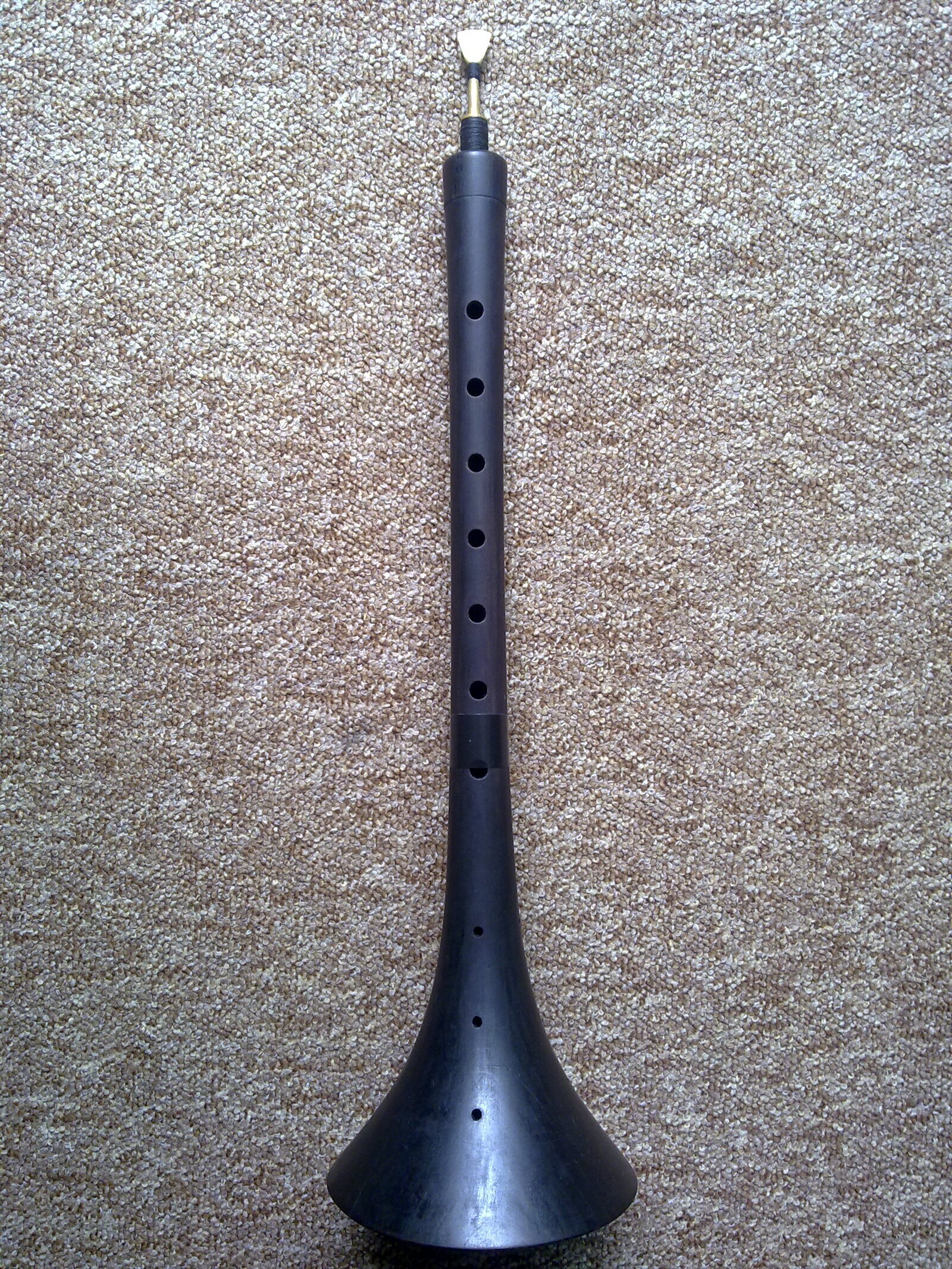 Photo via Wikimedia Commons, CC BY-SA 4.0
The zurna
Established The zurna is a conical-bore double-reed instrument, roughly 30–60 cm long, with a flared bell at the bottom. It produces a powerful, penetrating sound that carries over long distances outdoors — a necessity for its primary context: public celebrations, weddings, and circumcision festivities.
Established The zurna is almost always paired with the davul (large double-headed drum). The davul-zurna duo is one of the most widespread instrumental combinations in Anatolian folk music, found from the Balkans to Central Asia. The davul provides rhythmic drive; the zurna provides melodic content.
Attested The zurna's playing technique involves circular breathing — a method of inhaling through the nose while simultaneously exhaling air stored in the cheeks into the instrument, allowing continuous sound without pausing to breathe. This technique enables the sustained melodic lines that characterize zurna performance.
Practice The zurna's volume and timbre place it outside the classical makam tradition. It is not a concert-hall instrument. But zurna players operate within modal frameworks — the melodic patterns of Anatolian folk music overlap with (and historically influenced) the makam system, and skilled zurna players demonstrate sophisticated modal knowledge within their folk repertoire.
The mey
Attested The mey (also called balaban in Azerbaijan) is a cylindrical-bore double-reed instrument with a much softer, warmer tone than the zurna. Its reed is wider and produces a more controlled, intimate sound suited to indoor performance.
Attested The mey is traditionally associated with the music of eastern Anatolia, particularly the Armenian, Azerbaijani, and Kurdish musical traditions of the region. Its warm, slightly nasal timbre has led to its adoption in Turkish classical and contemporary music, where it provides a timbral color distinct from both the ney (end-blown flute) and the zurna.
Practice The mey's softer volume and greater dynamic control make it suitable for concert performance and recording in ways the zurna is not. Contemporary Turkish musicians have integrated the mey into classical and crossover contexts, expanding its role beyond its folk origins.
Construction differences
Attested The key structural difference between zurna and mey determines their sound:
| Feature | Zurna | Mey |
|---|---|---|
| Bore | Conical (flares outward) | Cylindrical (straight) |
| Reed | Small, hard | Large, soft |
| Bell | Wide, flared | Minimal or absent |
| Volume | Very loud | Moderate |
| Range | ~2 octaves | ~1.5 octaves |
| Context | Outdoor, ceremonial | Indoor, concert |
Established The zurna's conical bore amplifies higher harmonics, producing its characteristic bright, piercing quality. The mey's cylindrical bore emphasizes the fundamental and lower harmonics, producing a darker, more mellow tone.
Historical and cultural context
Attested The zurna has a long history in Ottoman military music. The Mehter (Janissary band) included zurna alongside davul, nakkare (kettledrums), and cymbals. This military context gave the zurna a prominent public role distinct from the indoor classical tradition of the tanbur and ney.
Practice For students of Turkish music, the zurna and mey represent a musical world adjacent to but distinct from the classical makam tradition. Their repertoire, technique, and performance contexts follow different conventions, but the modal sensibility — an ear for characteristic intervals and melodic patterns — crosses the boundary between folk and classical.
Where to go from here
The classical wind instrument: Ney. The folk stringed instrument: Bağlama/Saz. The bowed folk instrument: Kemençe. The court tradition: Ottoman Court Music.
Sources
- Karl Signell, Makam: Modal Practice in Turkish Art Music (Asian Music Publications, 1977)Textbook / peer-reviewed
- Wikipedia contributors, 'Zurna'Secondary sourceView sourceRetrieved 2026-07-30
- Wikipedia contributors, 'Mey (instrument)'Secondary sourceView sourceRetrieved 2026-07-30
External Resources
Between Frets is not affiliated with or sponsored by any of the resources listed below. Links are provided for educational purposes only.
- Davul Zurna — Wedding EntranceEstablished
Video documenting the living tradition of zurna-davul at a Turkish wedding entrance — the inseparable pairing where the davul provides rhythmic foundation and the zurna carries melody.
See the zurna in its primary social context — for many people, a wedding procession is the most common real-world encounter with the instrument.
Performance video exploring the relationship between the mey, duduk, and balaban — three nearly identical double-reed instruments distinguished primarily by regional and cultural context.
Demonstrates the sonic similarities and subtle differences between these closely related instruments, illustrating the article's discussion of the mey-duduk-balaban family.
Educational article covering the zurna's history, construction, and role in Anatolian musical traditions as one of the most important woodwind instruments of the region.
Accessible English-language reference for zurna history and construction details to accompany this article.
Academic paper by Songul Karahasanoglu providing an organological comparison of the mey (Turkish), balaban (Azerbaijani), and duduk (Armenian) as related instruments.
The most rigorous scholarly source available on the mey-balaban-duduk relationship — essential for understanding these instruments as regional expressions of a single family.
- Mey ImprovisationAttested
Solo mey improvisation demonstrating the instrument's warm, breathy tone and its capacity for melodic expression within Turkish modal frameworks.
Hear the mey's distinctive sound in isolation — its softer, more introspective voice contrasts with the zurna's outdoor projection.
Related Articles
- InstrumentsThe Ney: Construction, Technique, and TraditionA guide to the ney — the end-blown reed flute central to Turkish makam and Persian dastgah traditions, its demanding embouchure, and its place in Ottoman and Mevlevi musical practice.
- InstrumentsThe Kemençe: Classical and Black Sea TraditionsTwo instruments, one name — the pear-shaped classical kemençe of Ottoman court music and the narrow-bodied Karadeniz kemençesi of the Black Sea coast, their construction, playing technique, and distinct musical roles.
- HistoryOttoman Court Music: A Living TraditionThe rise, flourishing, and near-destruction of Ottoman classical music — from the Enderun palace school and the meşk tradition to the Mehter military band, the great composers, and the Republic-era suppression that nearly silenced it all.