The Kudüm: Kettledrums of Ottoman Classical Music
The kudüm is a pair of small copper kettledrums that serves as the primary percussion instrument of Turkish classical music. Played with two lightweight wooden sticks, the kudüm articulates the usul — the rhythmic cycle that governs composed forms — with a soft, clear attack that blends with the melodic instruments rather than dominating them.
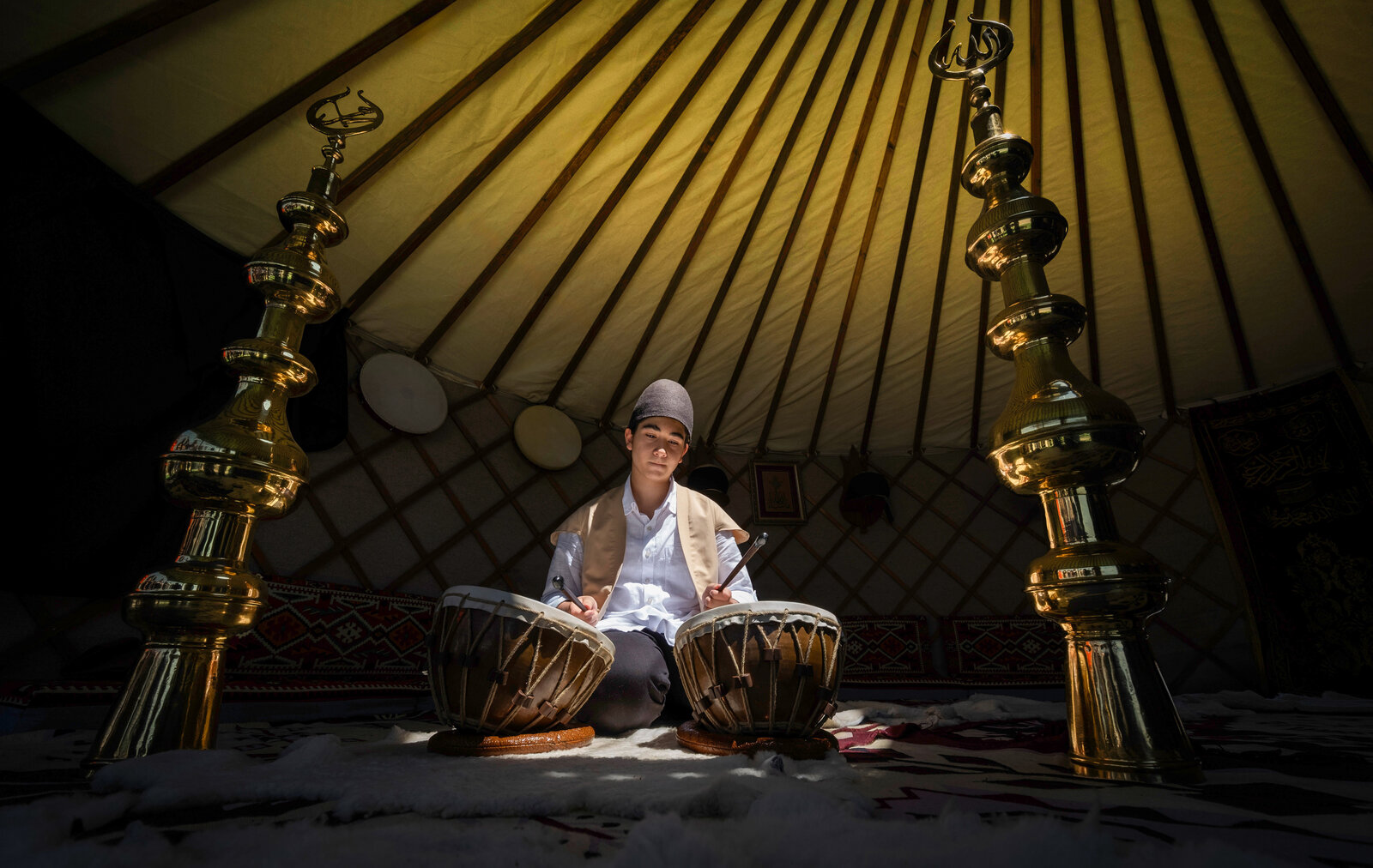 Photo via Wikimedia Commons, CC BY-SA 4.0
Construction
Established The kudüm consists of two hemispherical copper bowls, each approximately 28–30 cm in diameter, with goatskin or camel-skin heads stretched across the top. The two drums differ slightly in size: the larger one produces a lower-pitched dum stroke, and the smaller one produces a higher-pitched tek stroke.
Attested The drums sit on rings or cushions on the floor in front of the player, who sits cross-legged and strikes the drumheads with two wooden sticks (zahme). The sticks are lightweight, typically covered with leather or felt at the striking end, producing a controlled, moderate volume.
Practice The kudüm's volume is deliberately restrained. Unlike Western timpani or Middle Eastern davul, the kudüm does not project loudly. This is by design: in the intimate setting of Ottoman court performance and Mevlevi ceremony, the percussion must articulate rhythm without overwhelming the melodic instruments.
The dum-tek vocabulary
Established Like all Middle Eastern percussion, the kudüm produces two fundamental stroke types:
- Düm (dum): a lower-pitched stroke on the larger drum, corresponding to the strong beat of the rhythmic cycle
- Tek (tek/teke): a higher-pitched stroke on the smaller drum, corresponding to lighter beats and subdivisions
Established These two strokes, combined with silences, form the building blocks of every usul pattern. The notation system for usul — which appears in Özkan's treatise and other pedagogical sources — uses düm and tek symbols to represent each cycle.
The kudüm in the ensemble
Attested Feldman documents the kudüm as a standard member of the Ottoman fasıl ensemble. Its role is to maintain the usul throughout composed pieces — peşrev, saz semaisi, beste, and semai — providing a rhythmic framework that the melodic instruments follow.
Attested In the Mevlevi sema ceremony, the kudüm plays a particularly important role: it is one of the instruments that accompany the whirling, and the kudümzen (kudüm player) must maintain steady, precise rhythmic patterns through the ceremony's extended duration.
Practice The kudüm player in a classical ensemble functions as a timekeeper, but not a rigid one. In practice, the kudüm follows the melodic instruments' subtle tempo fluctuations — the slight accelerations and decelerations that give Turkish classical performance its breathing quality. The relationship is collaborative, not dictatorial.
Historical context
Attested The kudüm belongs to the nakkare family of paired kettledrums found across the Islamic world. Related instruments include the Arabic naqqara, the Persian naqqareh, and the Central Asian nagora. The Ottoman kudüm is the refined, chamber-music-scaled version of an instrument family that also includes large military drums.
Attested The instrument's association with both court and Sufi music reflects the Ottoman tradition's integration of secular and devotional performance. Many kudüm players served in both contexts, and the instrument's technique and repertoire crossed the boundary between saray (palace) and tekke (lodge).
Where to go from here
The rhythmic patterns it plays: Usul and Iqa. Frame drums of the region: Frame Drums. The forms it accompanies: Classical Forms. Its role in the sema: Mevlevi and Bektashi Traditions. The court it served: Ottoman Court Music.
Sources
- Walter Feldman, Music of the Ottoman Court (Intercultural Music Studies 10, VWB, 1996)Textbook / peer-reviewed
- Karl Signell, Makam: Modal Practice in Turkish Art Music (Asian Music Publications, 1977)Textbook / peer-reviewed
- İsmail Hakkı Özkan, Türk Musikisi Nazariyatı ve Usulleri (Ötüken, 2006)Textbook / peer-reviewed
External Resources
Between Frets is not affiliated with or sponsored by any of the resources listed below. Links are provided for educational purposes only.
Video demonstrating the kudum in the context of Turkish classical music performance, showing playing technique with the soft wooden zahme sticks.
One of very few dedicated kudum demonstration videos available — the instrument's ensemble role makes solo demonstrations rare.
- Kudsi Erguner — YOL: SufiEstablished
Mevlevi Sufi music performance by the Kudsi Erguner ensemble, providing essential context for the kudum's role alongside ney, rebab, and halile in the sema ceremony.
Hear the kudum in its primary historical context — the Mevlevi lodge, where the paired kettledrums provide the rhythmic framework for the whirling ceremony.
- The Orient Valley — Kudum GuideAttested
Educational article covering kudum construction (copper bodies, goat skin heads), playing technique, and the instrument's role in Turkish classical music.
Accessible English-language reference for kudum construction and technique details alongside this article.
Related Articles
- InstrumentsFrame Drums: Bendir, Daf, and RiqThe frame drum family in Middle Eastern classical and folk music — construction, technique, and the distinct roles of the Persian daf, North African bendir, and Arabic riq in makam and dastgah performance.
- RepertoireUsul and Iqa: Rhythmic Cycles in Ottoman and Arabic MusicAn introduction to usul, the cyclical rhythmic system of Turkish classical music, and its Arabic counterpart iqa — how they differ from Western meter, the dum/tek stroke vocabulary, common patterns, and their relationship to musical form.
- Turkish MakamTurkish Classical Forms: Peşrev, Saz Semaisi, Beste, and ŞarkıThe named composition forms of Ottoman/Turkish classical music — their structure, usul associations, and place within the fasıl suite — from the instrumental peşrev to the strophic şarkı that dominates the modern repertoire.