The Bağlama (Saz): Anatolia's Long-Necked Folk Lute
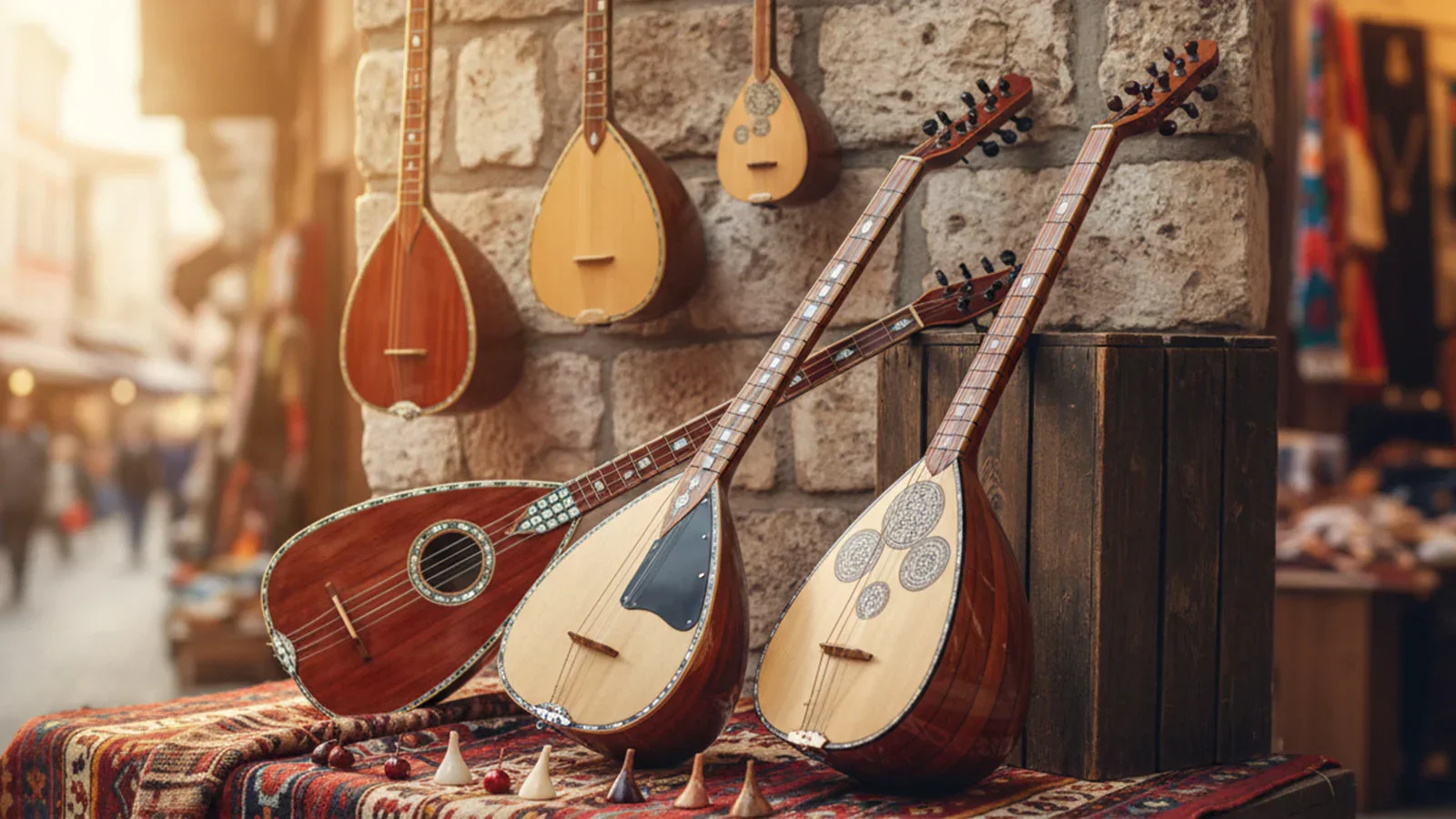
The bağlama is a long-necked, fretted plucked lute — the principal folk instrument of Turkish music and the voice of the âşık bardic tradition. Known interchangeably as "saz" (a word that also means "instrument" in general), it belongs to the wider tanbur family of long-necked lutes distributed across Iran, Mesopotamia, Central Asia, and Anatolia.
Names and terminology
Established The terms "bağlama" and "saz" are used somewhat interchangeably in Turkey. "Bağlama" derives from the Turkish verb bağlamak ("to tie" or "to bind"), likely referring to the tied frets on the instrument's neck. "Saz" functions more broadly — in Turkish it can mean "instrument" in a generic sense, referring to a single instrument or a group of instruments. In practice, when someone says "saz" without further qualification, they almost always mean the bağlama.
A family of sizes
Established The bağlama is not a single instrument but a family of three sizes, related by octave intervals:
| Size | Register | Role |
|---|---|---|
| Cura | Highest | The smallest member, often used for melodic lines |
| Tambura / Bağlama | Middle | The standard size, one octave lower than the cura |
| Divan sazı | Lowest | The largest member, two octaves lower than the cura |
Attested The cura is found in nearly every region of Turkey with varying exact dimensions, tunings, playing techniques, and regional names — including dede sazı, parmak cura, üç telli cura, bağlama curası, and tanbura curası. A notable variant is the two-stringed Kozağaç cura from the Teke region. All three sizes share the same basic construction and moveable-fret system; they differ in body size, string gauge, and sounding register.
Construction
Established The bağlama's bowl-shaped body (tekne) is carved or assembled from mulberry wood, juniper, beech, spruce, or walnut. The flat soundboard (göğüs) is typically spruce. The long neck (sap) is made from beech or juniper.
Established The strings are arranged in three courses — groupings of strings tuned in unison or octaves, not individual strings. Each course is plucked as a unit, producing the instrument's characteristic ringing, chorused tone. The number of individual strings per course varies by instrument size and regional tradition.
Established The bağlama is played with a tezene or mızrap — a small plectrum traditionally cut from cherrywood bark, now commonly made from plastic. Attested Some regional traditions, particularly in the Teke region of southwestern Anatolia, use a fingerstyle technique called şelpe (or şerpe), where the right-hand fingers pluck the strings directly without a plectrum.
The moveable fret system
Established The bağlama's frets are lengths of gut, nylon, or fishing line tied around the neck. Because they are tied rather than fixed, they can be repositioned — this is the instrument's most important design feature. Moveable frets allow the player to adjust intervals for different modal contexts, producing the microtonal pitches essential to Turkish folk and art music.
Established A standard bağlama carries approximately 17 frets per octave, producing intervals that approximate quarter tones — intervals that do not exist on Western instruments like the guitar. The traditional fret positions were documented by Yalçın Tura as a set of 17 ratios, running from 18/17 (fret 1) to 2/1 (the octave at fret 17). These ratios do not correspond to 12-tone equal temperament.
Attested Modern instrument makers increasingly use fret calculators based on 24-tone equal temperament, which allows the bağlama to also play 12-tone compositions. This is a pragmatic adaptation — the traditional fret positions remain in use for folk and modal music.
Practice The moveable frets mean that two bağlamas in the same room may not have identical intonation. Players adjust fret positions to suit their regional tradition, their teacher's approach, or the specific düzen (tuning system) they are using. There is no single "correct" fret placement the way there is on a guitar.
Tuning systems (düzen)
Established The bağlama has an unusually large number of named tuning systems — called düzen — each associated with a different regional tradition, genre, or modal context. More than a dozen are in common use. A düzen specifies the pitch relationship among the instrument's three courses (bottom, middle, top), typically given relative to a reference pitch of A.
Some widely used düzen include:
| Düzen | Courses (bottom / middle / top) | Notes |
|---|---|---|
| Bozuk (Kara) | A / D / G | One of the most common tunings, with several regional variants |
| Bağlama düzeni | A / D / E | Associated with standard bağlama practice |
| Kayseri | A / E / A | Named for the central Anatolian city |
| Misket | A / D / F# | |
| Müstezat | A / D / F | |
| Rast | A / C / G | Named after the makam |
| Abdal | A / A / G |
Practice A student starting out will typically learn bağlama düzeni or bozuk düzen first. The other tunings are not alternatives to be chosen once — a working player shifts between düzen as the repertoire demands. Learning to retune fluently is itself a skill.
The âşık tradition
Established The bağlama is inseparable from the âşık (also spelled aşık) — the Turkish and Azerbaijani poet-musician-bard who sings while accompanying on the saz. The word âşık comes from Arabic, meaning "one who is in love" or "lovelorn." The tradition unifies poetry and music under the principle of saz and söz — literally "instrument and word" — where neither element is subordinate to the other.
Attested The âşık tradition has roots in pre-Islamic Turkic culture and the earlier figure of the ozan — a Central Asian Turkic bard and storyteller. The term "âşık" gradually superseded "ozan" during the 15th and 16th centuries, reflecting the influence of Islamic and specifically Sufi culture on the existing bardic tradition, but the practice of itinerant poet-musicians accompanying themselves on a long-necked lute is far older.
Established A central performance practice is deyişme — verbal dueling — in which two âşıks improvise verses in response to each other's riddles and challenges, demonstrating both poetic invention and musical skill simultaneously. The bağlama accompanies throughout, and the performer's command of the instrument is judged alongside the verses.
Attested The âşık Pir Sultan Abdal, a seminal figure in the Alevi tradition, exemplified the role of the bağlama in religious and devotional expression as well as secular folk culture. The most celebrated modern âşık, Aşık Veysel Şatıroğlu (1894--1973), was a bağlama virtuoso and the defining representative of the Anatolian âşık tradition in the 20th century.
Established In 2009, UNESCO recognized the "Art of Azerbaijani Ashiq" as Intangible Cultural Heritage of Humanity, acknowledging the living continuation of the tradition across the broader region.
Folk music and art music
Established The bağlama developed in Anatolia as the principal folk lute of Turkish folk music, and that remains its primary identity. It is the instrument most associated with türkü — Turkish folk song — across every region of the country.
Attested The bağlama's role in Turkish art music (klasik Türk müziği) has historically been secondary. Art music traditions centered on the tanbur, oud, and ney rather than the bağlama. However, folk musicians performing makam-based repertoire on the bağlama use the same modal vocabulary — makam, perde, cesni, seyir — that structures art music, even when the specific intonation and ornamental practice differ.
Practice For a student of Turkish makam who plays the bağlama, the moveable fret system offers both an advantage and a challenge compared to the fretless oud: the frets provide tactile reference points for pitch positions, but they must be correctly placed for the makam being performed. A fret in the wrong position teaches the wrong intonation. This is why the relationship between fret placement and the makam system matters — the bağlama is not "easier" than the oud, it is differently demanding.
Central Asian connections
Established The bağlama belongs to the tanbur family — a group of long-necked lutes distributed from Iran and Mesopotamia across Central Asia and Anatolia, with roots traceable to at least the third millennium BCE.
Attested The kopuz (also komuz or qomuz) — an ancient fretless Turkic instrument traditionally made from a single piece of wood — is often cited as a Central Asian ancestor of the bağlama. The kopuz appears in the Book of Dede Korkut, the foundational epic of Oghuz Turkic oral literature, where the legendary figure Dede Korkut is credited as its inventor. The kopuz holds deep cultural significance across Central Asia — it appears on Kyrgyzstan's national currency.
Uncertain The exact evolutionary path from the Central Asian kopuz to the modern Anatolian bağlama is not clearly documented. The two instruments differ fundamentally — the kopuz is fretless, while the bağlama's tied frets are its defining feature. The relationship is best understood as belonging to a shared family of Turkic long-necked lutes rather than as a direct line of descent from one specific instrument to another.
Comparison with other long-necked lutes
| Bağlama (saz) | Setar | Tanbur | |
|---|---|---|---|
| Tradition | Turkish folk | Persian classical | Turkish art music |
| Frets | Tied, moveable | Tied, moveable | Tied, moveable |
| Playing method | Tezene (plectrum) | Fingernail | Long, thin mızrap |
| Courses | 3 | 3 (4 strings) | Multiple |
| Body | Carved bowl | Carved mulberry | Staved ribs |
| Primary role | Folk song (türkü) | Radif performance | Makam demonstration |
The bağlama shares its moveable-fret principle with the Persian setar, but the two instruments serve different musical systems, are tuned differently, and use different playing techniques. The Turkish tanbur is the art music instrument whose fret system most directly demonstrates the comma-level intonation of makam theory — see Holdrian Commas.
Sources
- New Grove Dictionary of Music and Musicians, s.v. "Bağlama"Textbook / peer-reviewed
- Yalçın Tura, Türk Musikisinin Mes'eleleri (Istanbul: Pan Yayıncılık, 1988)Textbook / peer-reviewed
- Scheherezade Qassim Hassan et al., "Tanbūr," in New Grove Dictionary of Music and Musicians (Macmillan, 2001)Textbook / peer-reviewed
- Wikipedia contributors, "Bağlama"Secondary sourceView sourceRetrieved 2026-07-30
- Wikipedia contributors, "Cura (instrument)"Secondary sourceView sourceRetrieved 2026-07-30
- Wikipedia contributors, "Ashik"Secondary sourceView sourceRetrieved 2026-07-30
External Resources
Between Frets is not affiliated with or sponsored by any of the resources listed below. Links are provided for educational purposes only.
- Asik Veysel SatirogluEstablished
Archival recordings of perhaps the most iconic saz player and poet in Turkish history. Blind from age 7, he devoted himself to the centuries-old Anatolian ashik bardic tradition.
Essential listening for understanding the ashik tradition that the baglama embodies — Asik Veysel is the cultural touchstone for the instrument's folk identity.
- Erkan Ogur — Sound Tracker (Documentary)Established
Episode from the Sound Tracker documentary series featuring Erkan Ogur in Turkey, showing his instruments, technique, and musical philosophy including the fretless guitar he invented.
Watch a master who invented the fretless classical guitar to access Turkish microtonal intervals — directly relevant to the site's 'between frets' concept.
- Barak Saz & BaglamaAttested
Described as the world's first online course in English for saz-baglama, offering structured video lessons at various levels for self-paced learning.
One of the very few English-language structured baglama lesson series — invaluable for non-Turkish-speaking students.
- Erdal Erzincan (@erdalerzincan)Established
Verified account (405K followers) of the Turkish Alevi folk musician, composer, and key contributor to the selpe (fingerpicking) technique. Concert announcements and workshop content.
Follow one of the most important living baglama players for contemporary performance content and information about his traveling baglama workshop.
- Turkish Music Portal — Baglama FamilyEstablished
Comprehensive reference on the baglama family of instruments in Turkish folk music, including all sizes and regional variants from cura to divan saz.
The most authoritative institutional English-language reference for the full baglama instrument family and its place in Turkish folk music.
- Erdal ErzincanAttested
SoundCloud profile for one of the foremost living baglama players, known for the selpe technique and his role in the Arif Sag-Erzincan-Parlak trio.
Access baglama recordings that may include live concert material and rare tracks not available on mainstream streaming platforms.
- Erol Parlak — Baglama MethodEstablished
Baglama method book by virtuoso and academician Erol Parlak, available in English, German, and Turkish with DVD covering diverse playing techniques.
One of the most thorough baglama instruction methods available to non-Turkish speakers, from a player awarded the Neset Ertas Golden Baglama Award.
Field study documenting baglama instruction through the mesk method in Bolu, Turkey.
Empirical documentation of how oral transmission through masters shaped baglama repertoire -- one of the few studies grounding mesk in specific instrument pedagogy.
Academic paper comparing historical tuning systems across tanbur, oud, tar, and saz
Primary source for cross-instrument tuning analysis — directly compares the tuning systems of instruments covered on this site
Related Articles
- Tuning SystemsHoldrian Commas and 53-TET: The Mathematics of Ottoman TuningHow the 53-tone equal temperament system and Holdrian commas became the theoretical language of Turkish makam intonation.
- InstrumentsThe Oud: History, Construction, and Playing TraditionsA guide to the oud — its deep history, bowl-back construction, fretless technique, and the distinct Turkish and Arabic traditions it anchors.
- Turkish MakamPerde: The Named Pitch Positions of Turkish MakamThe complete perde system — the named pitch positions that define Turkish makam music, their Holdrian comma values, Persian-derived names, and the gap between theoretical positions and performed intonation.