Kantemiroğlu Notation: The First Ottoman Music Manuscript
Before the 20th century's adoption of modified Western staff notation, Ottoman classical music had no standardized way to write itself down. The repertoire lived in the memories of master musicians, transmitted through meşk — face-to-face, ear-based instruction. One extraordinary exception survives: the manuscript of Dimitrie Cantemir, known in Turkish as Kantemiroğlu, who created an alphabetic notation system and used it to record the largest surviving collection of 17th-century Ottoman instrumental music.
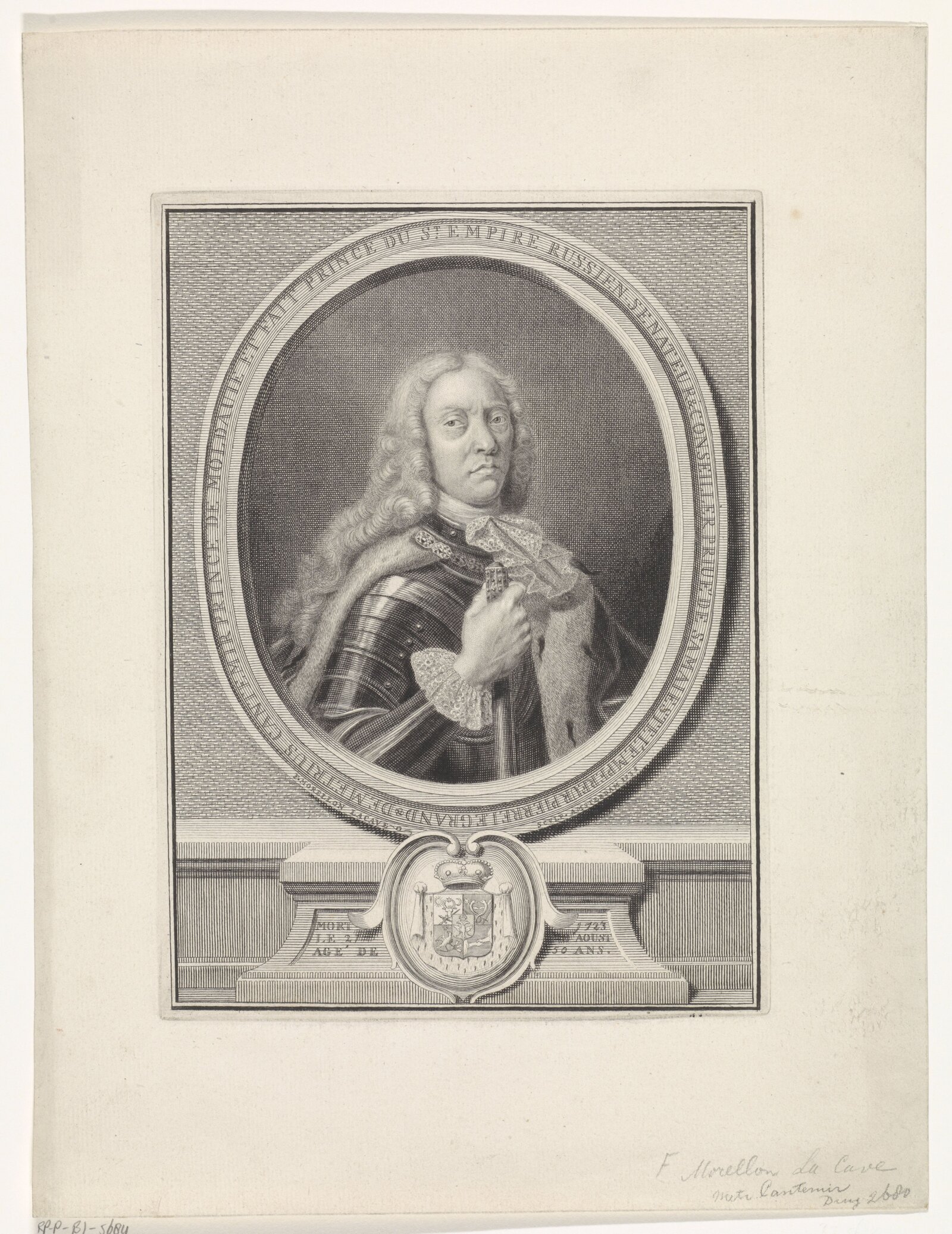 Portrait of Dimitrie Cantemir, courtesy of the Rijksmuseum, Public Domain
The prince musician
Established Dimitrie Cantemir (1673–1723) was a Moldavian prince who spent over two decades in Istanbul as a political hostage and diplomatic figure at the Ottoman court. Far from being a passive captive, he immersed himself in Ottoman culture — studying music, literature, and philosophy. He became a skilled tanbur player and gained admission to the elite circle of court musicians.
Attested Cantemir was a polymath by any standard: he wrote the first systematic history of the Ottoman Empire (Historia Incrementorum atque Decrementorum Aulae Othomanicae), contributed to the Berlin Academy of Sciences, and corresponded with Leibniz. His musical treatise was one product of a far broader intellectual project.
The treatise
Established Cantemir's musical work, titled Kitābu 'İlmi'l-Mūsīḳī 'alā Vechi'l-Hurūfāt ("Book of the Science of Music through Letters"), accomplishes two things: it presents a theoretical exposition of the Ottoman makam system as understood in the late 17th century, and it preserves approximately 355 instrumental compositions — peşrevler and saz semaileri — in his own notation.
Attested Yalçın Tura's 2001 critical edition published the full manuscript with modern transcriptions and extensive commentary. Eugenia Popescu-Judetz's study situates Cantemir within the broader Ottoman musical context and examines his contributions as both theorist and composer.
The notation system
Attested Cantemir's notation uses Arabic/Ottoman letters to represent pitches. Each named perde receives a specific letter, creating a one-to-one mapping between alphabetic symbols and pitch positions. Rhythmic values are indicated through additional symbols and spatial arrangement.
Attested The system is not staff notation. It reads horizontally, with each letter standing for a specific pitch in the makam's vocabulary. A musician familiar with the perdeler can decode the letter sequence into a melody, though the notation captures pitch and rhythm more reliably than it captures ornamental detail, dynamics, or the subtle inflections that distinguish one performer's interpretation from another's.
Practice This is the central limitation of any notation for this music: it preserves the skeleton of a composition but not the flesh. What meşk transmitted — ornamental conventions, microtonal inflections, phrasing habits, the "feel" of a makam — cannot be fully captured in any notation, alphabetic or otherwise. Kantemiroğlu's manuscript tells us which notes were played, in what order, with what rhythmic values. It cannot tell us exactly how they sounded.
What the manuscript preserves
Established The approximately 355 compositions in the manuscript constitute the largest surviving body of Ottoman instrumental music from the 17th century. They include peşrevler and saz semaileri in a wide range of makams and usul, providing direct evidence of the repertoire that court musicians performed during the reign of Ahmed III and the preceding decades.
Attested Feldman draws extensively on the Kantemiroğlu collection in Music of the Ottoman Court, using it as primary evidence for the state of the repertoire, the relative popularity of different makams, and the formal conventions of instrumental composition in the period.
Attested Some of the compositions preserved in the manuscript survive in the modern repertoire — their melodies transmitted through meşk chains that run parallel to Cantemir's written record. Where the two sources agree, they confirm each other. Where they diverge, the differences reveal how oral transmission transforms compositions over centuries.
Pre-AEU evidence
Attested For scholars of Turkish music theory, the Kantemiroğlu manuscript has a specific importance beyond repertoire preservation: it documents makam practice as it existed roughly 250 years before the Arel-Ezgi-Uzdilek system was formalized. Cantemir's theoretical descriptions of makams — their perdeler, their characteristic intervals, their seyir — do not always match what AEU theory would predict for the same makam names.
Uncertain The significance of these discrepancies is debated. They might reflect genuine historical changes in how makams were practiced, or they might reflect differences between Cantemir's theoretical understanding and what performers actually did, or they might result from ambiguities in the notation itself. Disentangling these possibilities requires exactly the kind of careful, source-critical scholarship that Tura and Popescu-Judetz have pursued.
Practice For learners, the key takeaway is this: the makam system was not fixed in the 17th century and codified unchanged into AEU theory. It is a living tradition that has evolved, and Cantemiroğlu's manuscript provides the clearest window into what it looked like at an earlier stage.
Legacy
Attested Cantemir was not the only Ottoman-era figure to attempt musical notation — Ali Ufki (Wojciech Bobowski), a Polish captive at the Ottoman court a generation earlier, also notated Ottoman music using a form of Western staff notation. But Cantemir's collection is vastly larger and uses a system designed specifically for Ottoman music's pitch vocabulary, making it the more important source for musicological research.
Practice The Kantemiroğlu manuscript demonstrates that the impulse to notate — to freeze music in writing — is not a Western import. Ottoman musicians felt the same tension between the flexibility of oral tradition and the fragility of unwritten repertoire. Cantemir's solution was different from the AEU system that came two centuries later, but the problem he addressed was the same.
Where to go from here
The court tradition he documented: Ottoman Court Music. The notation that replaced his: Arel-Ezgi-Uzdilek. Notation systems compared: Notation Systems. The theorist whose work preceded his: Safiyüddin Urmevi. The forms he preserved: Classical Forms.
Sources
- Eugenia Popescu-Judetz, Prince Dimitrie Cantemir: Theorist and Composer of Turkish Music (Editions Pan, 1999)Textbook / peer-reviewed
- Yalçın Tura, Kantemiroğlu: Kitâbu İlmi'l-Mûsîkî alâ Vechi'l-Hurûfât (Yapı Kredi Yayınları, 2001)Textbook / peer-reviewed
- Walter Feldman, Music of the Ottoman Court (Intercultural Music Studies 10, VWB, 1996)Textbook / peer-reviewed
- Wikipedia contributors, 'Dimitrie Cantemir'Secondary sourceView sourceRetrieved 2026-07-30
External Resources
Between Frets is not affiliated with or sponsored by any of the resources listed below. Links are provided for educational purposes only.
Official Turkish cultural resource documenting Ottoman court music, including the institutional context in which Kantemiroğlu produced his manuscript.
Provides the court music environment in which Kantemiroğlu worked and the meskhane tradition his notation attempted to capture.
Comprehensive Turkish music resource with notation archives organized by musical category, including sacred vocal pieces, classical compositions, and Mevlevi ceremonial music.
Modern notation archive that inherits the same preservation impulse behind Kantemiroğlu's manuscript -- capturing an oral tradition in written form.
- Brill: Music of the Ottoman CourtEstablished
Academic publication covering the early Ottoman instrumental repertoire, with detailed treatment of Kantemiroğlu's manuscript and its significance.
Peer-reviewed scholarly analysis of the same manuscript this article examines, by Walter Feldman whose research forms a primary source for this article.
Related Articles
- HistoryOttoman Court Music: A Living TraditionThe rise, flourishing, and near-destruction of Ottoman classical music — from the Enderun palace school and the meşk tradition to the Mehter military band, the great composers, and the Republic-era suppression that nearly silenced it all.
- TheoryNotation Systems for Microtonal Music: Writing What Lives Between the NotesHow Turkish, Persian, and Arabic traditions adapted — and resisted — Western staff notation to capture microtonal intervals that standard notation cannot express.
- HistorySafiyüddin al-Urmawi: The Foundation of Ottoman-Persian Music TheoryHow a 13th-century theorist at the Abbasid court produced two treatises that shaped makam and dastgah theory for seven centuries — his 17-tone scale, systematic interval classification, and enduring influence on Arel, Maraghi, and modern conservatory pedagogy.