Resources / Instruments / Fretless technique and ornament vocabulary
Fretless technique and ornament vocabulary
Intonation is relational, not absolute
Established On a fretted instrument, correct pitch is a location. On a fretless instrument in makam music, correct pitch is a relationship — to the karar, to the open strings, to the pitch you just played.
The practical consequence is that all practice should happen over a drone. Playing scales unaccompanied on a fretless instrument trains nothing, because there's no reference against which "correct" means anything. This should be a default-on feature in the app, not an option.
Reference points
Reliable anchors on any fretless neck:
| Point | Where | Why reliable |
|---|---|---|
| Octave | Exactly half the string | Strong beating against the open string when wrong |
| Fifth | ~1/3 from the nut | Very consonant; easy to hear |
| Fourth | ~1/4 from the nut | Matches the adjacent open string in fourths tunings |
In an all-fourths tuning, the fourth position on any course sounds the next open
string. That's a free self-check across the whole neck, and it's the strongest
argument for learning cümbüş standart early even if you play in another tuning.
Ornament vocabulary
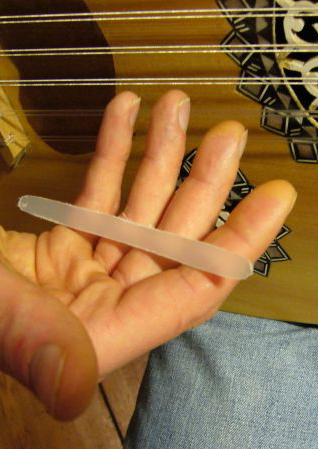
Established The ornaments are not decoration — in this repertoire they carry much of the identity. A correct scale played plainly does not sound like the music.
| Ornament | Turkish | What it is |
|---|---|---|
| Slide | glissando / kaydırma | Continuous pitch travel between notes. The signature fretless gesture. |
| Grace note | çarpma | Fast single-note approach, usually from above or a step below |
| Trill | tril | Rapid alternation with the note above |
| Vibrato | Narrow and fast in Turkish style; wider in some Arabic playing | |
| Mordent | Quick down-up or up-down flick |
Practice The slide is what a fretless instrument can do that a keyboard and a fretted guitar cannot. It is also how the microtonal pitches are often approached — a player may arrive at a neutral second by sliding into it rather than placing it. The app should teach approach, not just placement.
The clarinet problem
Practice Much of the Turkish Roman repertoire a cümbüş player wants to learn is clarinet music. The ornament vocabulary is wind vocabulary: fast runs, breath-shaped phrases, slides that a wind player produces with embouchure and half-holing.
Some transfers well — the cümbüş's fretless slide is a genuine analogue for the clarinet's, which a guitar can never be. Some doesn't. Fast ornamental runs at wedding tempo are brutal on a plucked instrument.
Recommended approach: learn the melodic skeleton first at half tempo, add ornaments second, accept that some clarinet gestures simply won't transfer.
Practice sequence for intonation
- Drone on the karar. Find the octave. Hold it until the beating stops.
- Find the fifth. Same.
- Find the fourth — check it against the adjacent open string if the tuning allows.
- Fill in the çeşni between those anchors.
- Only then play the full makam.
This is the reverse of scale-first practice, and it is how the ear actually builds a map.
App implications
- Drone is default-on. Not a toggle buried in settings.
- Anchor points should be visually distinct from ordinary scale degrees — octave, fifth and fourth are structurally different from the notes between them.
- Approach direction matters. If the app ever generates exercises, a neutral second approached from below and from above are two different exercises.
- Slides should be synthesisable. A pitch-glide between two notes is trivial in the audio engine and would demonstrate the core fretless gesture the app is ostensibly about.
Sources
- Karl Signell, Makam: Modal Practice in Turkish Art Music (rev. ed., Usul Editions, 2008) — on ornamentation and intonation practice
- Johnny Farraj and Sami Abu Shumays, Inside Arabic Music: Arabic Maqam Performance and Theory in the 20th Century (Oxford University Press, 2019) — on ornament vocabulary and approach-by-slide practice
- Sonia Tamar Seeman, Sounding Roman: Representation and Performing Identity in Western Turkey (Oxford University Press, 2019) — on the clarinet-derived ornament vocabulary in Turkish Roman repertoire